
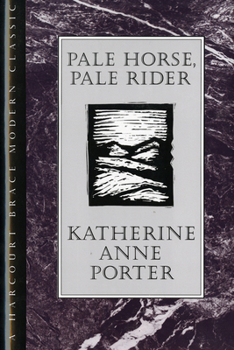
"Most good stories are about the interior of our lives, but Katherine Anne Porter's stories take place there," said Eudora Welty. "They show surface only at her choosing." Pale Horse, Pale Rider comprises three of the Pulitzer Prize-winning author's short novels or long stories, as Porter--who didn't hold with the term "novella"--called her pieces. In the masterly "Noon Wine," set on a Texas farm circa 1900, she offers an unforgettable study of evil. According to Reynolds Price the tale "can stand shoulder to shoulder with anything in Tolstoy or Chekhov." Both "Old Mortality" and the title story center on Porter's fictional counterpart, Miranda: a resilient Southern heroine who, as Mary Gordon observed, is in "the precarious position of a woman who must earn her way with no one behind her to break her fall." "Many of Katherine Anne Porter's stories are unsurpassed in modern fiction," said Robert Penn Warren. "Miss Porter has the power that Chekhov or Frost or Ibsen, or sometimes Pound, has, the power to make the common thing glow with an Eden-like innocence." And The Saturday Review stated, "Porter moves in the illustrious company headed by Hawthorne, Flaubert, and Henry James." --The Modern Library has played a significant role in American cultural life for the better part of a century. The series was founded in 1917 by the publishers Boni and Liveright and eight years later acquired by Bennett Cerf and Donald Klopfer. It provided the foundation for their next publishing venture, Random House. The Modern Library has been a staple of the American book trade, providing readers with affordable hardbound editons of impor-tant works of literature and thought. For the Modern Library's seventy-fifth anniversary, Random House redesigned the series, restoring as its emblem the running torchbearer created by Lucian Bernhard in 1925 and refurbishing jackets, bindings, and type, as well as inaugurating a new program of selecting titles. The Modern Library continues to provide the world's best books, at the best prices.--With an Introduction by Elizabeth Hardwick.
Katherine Anne Porter writes like a lapidary; each sentence is like a polished jewel, every word is perfect. "Pale Horse, Pale Rider" is a compilation of three novellas: "Old Mortality", seen through the eyes of Maria and Miranda Rhea, two children home for the weekend from their stultifying boarding school, is the tale of the family black sheep, a beautiful young cousin of easy virtue who continues to fascinate and frustrate her extended family long after her early death; "Noon Wine" shows us a Texas family torn apart by the guilt of the father who murdered a man in what may or may not have been self-defense, and "Pale Horse, Pale Rider" brings Miranda back again as a young woman disillusioned too many times, whose relationship with her lover Adam is threatened not only by his impending entry in to combat in World War One, but even more immediately by the specter of the great flu epidemic of 1918 that is sweeping through the population, leaving more death in its wake than any war ever fought. Porter writes sparingly, but she packs a world of emotion and feeling into every paragraph. This relatively short book is one of the giants of American fiction.
Short fiction the way it should be.
Published by Thriftbooks.com User , 24 years ago
Katherine Anne Porter displays the human experience with turns of phrase that catch your breath. The awkward spinster cousin blooms "like a dry little plant set out in a gentle rain" when her critical mother leaves the room. A woman delirious with influenza falls into a sleep "that was not sleep but clear evening light in a small green wood..."I thought Flannery O'Connor had ruined all other southern short fiction writers for me, but Porter meets O'Connor's deft character portraits, with their keen knowledge of mannerisms and their psychological depth, as well as O'Connor's ability to surprise the reader with moments of recognition: Miranda's girlhood experience feels like my girlhood experience, across generations and geography. Even Mr. Thompson's story feels like it could have happened in one's own family, like the story grandparents and great aunts and uncles half-tell and subtly refer to while the turkey roasts in the oven and everyone steals nuts off the pecan pie.I agree with others who are astonished that this book is not part of the literary canon in the U.S. It is a stunning, gorgeous example of short fiction. With the impenetrable heaps of "literary fiction" from contemporary writers, marketed to ridiculous heights, I'm finding old gems like this one soothing to my constantly inundated reader's mind. Read it. And writers, take note.
A great work of art which deserves to be far more well-known
Published by Thriftbooks.com User , 24 years ago
I first read this book about thirty-five years ago, as a young teenager. At the time, I didn't really know what it was about, lacking the historical background to understand World War I, and having no knowledge whatsoever of the widespread influenza epidemic of 1918. Nevertheless, the memory of Porter's shimmering prose somehow stayed with me, leading me to read the story once again, this time as an adult, and to finally comprehend it better. In fact, I have reread it several times over the years, always profoundly moved by the experience. Recently, after the events of September 11, 2001, I found myself thinking again of the story, and hauled it out of the library for still another reading. It is more beautiful and meaningful than ever. It has the powerful force of deeply felt, true experience.
pale handed prose
Published by Thriftbooks.com User , 24 years ago
I think the author that Katherine Anne Porter is most often compared to is Thomas Mann. Both wrote their best known work in the novella form and both use a highly distilled prose which is rich in symbols. Death in Venice and Pale Horse Pale Rider(both dealing with plagues of some sort) are two of the best novellas you are likely to come across, both appear in most novella collections(even though Porter didn't much care for that word). Porter evokes another author though as well, Mary Shelley, in Pale Horse Pale Rider. Being a male reader who doesn't read a lot of female authors I am always struck by something in authors like Dickinson and Woolf and Porter and Plath which is that distanced perspective, the writing seeming to come from somewhere outside of life, real life being only a memory. This may be a personal point of view only but in Pale Horse the main character Miranda, even before the epidemic hits, seems the perfect example of this phenomenon as she seems not to very much want to participate in the life around her. She may be tempted into something resembling life by her lover Adam but still she seems to be sleepwalking. So it is not all that surprising that when death does enter her chamber so to speak it is received as not an altogether unwelcome guest. Miranda's dream or vision is so well written and the pace of it so well sustained throughout that you feel you have accompanied her through it. One of those sequences you never quite forget. The coming to life again segment(Shelley)is also quite astonishing and strangely, eerily beautiful. The other two tales are good too but this is the one you will remember. There are many great romantic and symbolist(especially) paintings that you will feel you understand or have a strange communion with after having read this.
America's Most Proustian Novel
Published by Thriftbooks.com User , 25 years ago
This book clearly deserves more than five stars.Pale Horse, Pale Rider is one of the finest American novels of all time. Long before nonfiction books about dying and coming back to life became popular, Katherine Anne Porter wrote this brilliant story about life and death during the influenza epidemic near the end of World War I. Unlike any other book I have read on this subject, she successfully captures the perspective of the beauty of death eclipsing the beauty of life. The book further develops this theme to explain how our perspective shifts back towards favoring life, as the memory of death retreats. Like all great novels, this one transcends its obvious theme into a broader one -- the meaning of the inevitable death that ends each of our lives . . . and what life means in this context. One of the fascinating plot complications that she uses in this book is showing how "duty" to life usually means increasing the likelihood of death. As a result, you see death more visibly in front of you through this book than you ever will in every day life. The story begins with a young woman reporter who is concerned over the chance of losing her job because she has refused to buy a Liberty Bond. She feels she cannot afford it, and she doesn't want to buy one any way. The reason she cannot afford one is due to have been demoted for refusing to write a story about a young woman that another paper ran. As she races from social event to social event, while scribbling her short columns in between, she longs for a personal life and a future. She is attracted to a young man in the Army who is awaiting shipment abroad. She knows this relationship is hopeless. He will be gone in a few days. Also, on the front, people with his job of clearing mines usually die quickly. Against this potential for romance is an influenza epidemic that is taking many lives. Our heroine finds herself feeling a little under the weather. What happens next is described in some of the greatest writing about illness since Marcel Proust's Remembrance of Things Past. This is quite a short novel, so you can read it quickly. I suggest doing it in one sitting, if possible. In that way, the cadence of the inner voices of this story's progression will have a much stronger effect on you. I do recommend reading this on a weekend, though, early in the day. You might not sleep too well if you wait until late at night.After you have finished reading this novel, I suggest that you consider how you view death. Consider the event from several perspectives: emotional, intellectual, as an ending, and as a beginning. Also, look at other peoples' deaths as well as your own. If you do this carefully, I think you will see new perspectives that will be helpful to you. I remember how surprised I was when I first met people who saw death as an opportunity to happily celebrate the life of one of their friends. When I thought about my own reaction to that, I realized that I needed to spend
ThriftBooks sells millions of used books at the lowest
everyday prices. We personally assess every book's quality and offer rare, out-of-print treasures. We
deliver the joy of reading in recyclable packaging with free standard shipping on US orders over $15.
ThriftBooks.com. Read more. Spend less.

