


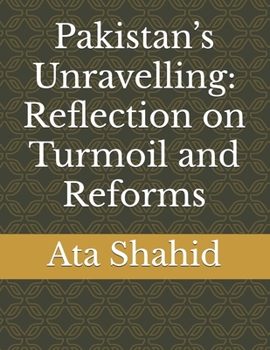
Pakistan's Unravelling: Reflection on Turmoil and Reforms

Pakistan's Unravelling: Reflections on Turmoil and Reforms provides an in-depth analysis of the challenges that have shaped Pakistan's trajectory since its inception. The book begins by examining the recurring political turmoil that has plagued Pakistan, focusing on the assassinations of key leaders like Liaquat Ali Khan, Zulfiqar Ali Bhutto, and Benazir Bhutto. It critiques the dynastic nature of politics, where families like the Bhuttos, Sharifs, and Ghaffar Khans have wielded disproportionate power, undermining democratic principles.
The administrative collapse of Pakistan's bureaucracy is another key focus, as it highlights the corruption, inefficiency, and incompetence that have turned this once-professional institution into a hindrance to development. Bureaucrats, often appointed based on political loyalty rather than merit, have failed to deliver basic services.This is compounded by Pakistan's economic decline, driven by external debt, reliance on IMF programs, and the absence of critical reforms such as land redistribution and agricultural taxation. The book criticizes the high defense spending and low tax-to-GDP ratio, which leave essential sectors like education, health, and infrastructure severely underfunded.
The book dedicates significant attention to the role of Independent Power Producers (IPPs) in exacerbating Pakistan's energy crisis. Flawed agreements with IPPs, including capacity payments, have led to exorbitant electricity costs for consumers, contributing to inflation and making exports uncompetitive. On the international front, Pakistan's foreign policy is critiqued for being overly influenced by the military and failing to balance its regional and global alliances. The book examines key missteps, such as the unbalanced stance during the Soviet and American occupations of Afghanistan, the inability to develop effective diplomatic ties with neighboring countries, and the failure of its Kashmir policy, especially after India's actions in August 2019.The judiciary's role in perpetuating political instability is also scrutinized. From Justice Munir's Doctrine of Necessity to the judicial complicity in Zulfiqar Ali Bhutto's execution, the book highlights how the legal system has been used to legitimize undemocratic actions. Judicial overreach and political interference have eroded public trust, although recent reforms, such as the 26th Constitutional Amendment, are seen as steps toward a controlled Judiciary.The rise of insurgent groups like the Baloch Liberation Army (BLA) and Tehrik-i-Taliban Pakistan (TTP) is explored in detail. The book examines the factors fueling these groups, including external support and the aftermath of the Taliban's return to power in Afghanistan.
One of the book's most compelling chapters discusses why Pakistan struggles to function as a "normal" country. Economic instability, weak rule of law, dynastic politics, and a security-state mentality are identified as key barriers to progress. The book critiques the prioritization of defense spending over social sectors, the exploitation of resources by powerful mafias, and the growing brain drain as disillusioned youth seek opportunities abroad. Religious and social polarization, fueled by sectarian clashes and unregulated madrassas, has further fragmented society.
The concluding chapter outlines a comprehensive vision for Pakistan's reformation. It emphasizes the need to address provincial grievances, particularly in Balochistan, Azad Kashmir, and Gilgit-Baltistan, to foster national unity. Economic reforms, including population control and investment in human development, are identified as critical for progress.
Pakistan's Unravelling is both a diagnosis of the country's deep-rooted challenges and a call to action for transformative reforms. By weaving together historical context, contemporary analysis, and forward-looking solutions, the book presents a sobering yet hopeful vision for Pakistan's
Customer Reviews
ThriftBooks ® and the ThriftBooks ® logo are registered trademarks of Thrift Books Global, LLC
