


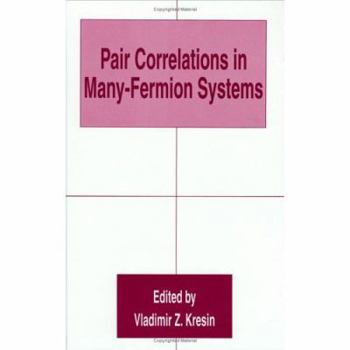
Pair Correlations in Many-Fermion Systems
No Customer Reviews

Select Format
Select Condition 
Book Overview
At first glance, the articles in this book may appear to have nothing in common. They cover such seemingly disparate subjects as the properties of small metallic clusters and the behavior of superfluid He3, nuclear physics and organic materials, copper oxides and mag- netic resonance. Why have they been brought together, particUlarly in our time of narrow spe- cialization? In fact, the properties and effects described in this book touch upon one and the same fundamental phenomenon: pair correlation. Introduced in the theory of superconductivity by J. Bardeen, L. Cooper, and J. Schrieffer (BCS), this effect plays a key role in various Fermi systems. The book consists of several sections. The first chapter is concerned with conven- tional and high Tc superconductors. The second chapter describes two relatively young fami- lies of superconductors: organics and fullerenes. Chapter III addresses the superfluidity of 3 He - The discovery of this phenomenon in 1971 was a big event in physics and last year was acknowledged by a Nobel prize. This book contains the text of the Nobel lecture. Chapters IV and V are devoted to correlations in finite Fermi systems such as small metallic clusters, C 60 anions, and atomic nuclei. The book thus covers a broad range of problems, illuminating the close ties between various areas of physics.
Format:Hardcover
Language:English
ISBN:0306458233
ISBN13:9780306458231
Release Date:February 1998
Publisher:Springer
Length:296 Pages
Weight:1.35 lbs.
Dimensions:0.8" x 6.1" x 9.2"
Customer Reviews
0 rating
Copyright © 2026 Thriftbooks.com Terms of Use
| Privacy Policy | Do Not
Sell/Share My Personal Information | Cookie Policy | Cookie Preferences | Accessibility Statement
ThriftBooks® and the ThriftBooks® logo are registered trademarks of Thrift Books Global, LLC
ThriftBooks® and the ThriftBooks® logo are registered trademarks of Thrift Books Global, LLC
