


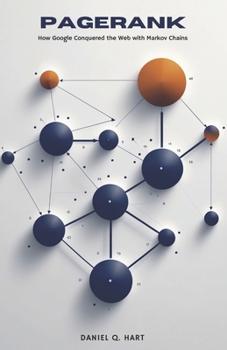
PageRank: How Google Conquered the Web with Markov Chains

Ever wondered how Google actually conquered the internet?
It wasn't magic. It was mathematics.
In 1998, two Stanford PhD students asked a deceptively simple question: What makes a web page important? Their answer-a brilliant application of probability theory called PageRank-didn't just improve search. It changed the world.
This book reveals exactly how they did it.
You'll discover the elegant mathematical framework that powered Google's rise from a dorm room project to a trillion-dollar company. But unlike dry academic texts, this book makes the mathematics genuinely accessible-no PhD required.
Inside, you'll master:
- The Random Surfer Model - How imagining a user clicking randomly through the web reveals hidden patterns of importance
- Markov Chains Explained Simply - The probabilistic framework that makes PageRank possible, broken down into crystal-clear examples
- Why Links Are Votes - The recursive insight that transformed how we rank information: important pages make the pages they link to important
- Real-World Engineering - How Google scaled this algorithm to billions of pages, and why "good enough" beat mathematical perfection
- The Damping Factor Solution - The clever trick that rescued PageRank from dead ends, spider traps, and other web graph nightmares
- Beyond Google - How PageRank principles now power social networks, academic citations, recommendation engines, and more
What makes this book different?
Most explanations of PageRank either dumb it down to meaninglessness or drown you in equations. This book walks the line perfectly. You'll build genuine understanding through clear examples, intuitive analogies, and step-by-step walkthroughs-then see how theory became practice at Google.
You'll learn:
The complete mathematical foundation (stationary distributions, eigenvectors, convergence)Why certain structural problems broke early search enginesHow Larry Page and Sergey Brin turned academic research into a search revolutionThe surprising winner among three calculation methods (hint: brute force)Why 50 iterations became the magic numberHow PageRank integrates with modern machine learning systemsPerfect for:
Curious minds who want to understand the algorithms shaping the internetStudents learning probability, linear algebra, or network scienceData scientists exploring graph algorithms and centrality measuresAnyone fascinated by the origin stories of transformative technologiesNo advanced mathematics required. If you can follow a logical argument and aren't afraid of a little notation, you can understand this. The book assumes only basic algebra and builds everything else from the ground up.
From the Markov chains that model random walks to the eigenvectors hiding in plain sight, you'll see how one elegant algorithm solved a problem billions of people rely on every single day.
Start your journey into the mathematics that conquered the web.
Scroll up and grab your copy now.
Customer Reviews
ThriftBooks ® and the ThriftBooks ® logo are registered trademarks of Thrift Books Global, LLC
