


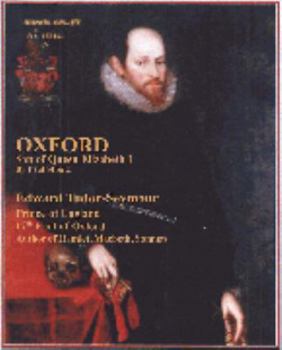
Oxford: Son of Queen Elizabeth I

Select Format
Select Condition 
Book Overview
In the summer of 1548, the thirteen-year-old Princess Elizabeth Tudor was secluded at Cheshunt, England. There she gave birth to a boy, whose father was Thomas Seymour, ElizabethÂ’s stepfather. The... This description may be from another edition of this product.
Format:Paperback
Language:English
ISBN:0971349800
ISBN13:9780971349803
Release Date:January 2001
Publisher:Oxford Inst Press
Length:340 Pages
Weight:1.35 lbs.
Dimensions:9.3" x 1.3" x 5.8"
Customer Reviews
5 ratings
Oxford As Elizabeth's Son, A Most Interesting Choice,
Published by Thriftbooks.com User , 17 years ago
Before reviewing Mr. Streitz's latest edition of "Oxford, Son of Queen Elizabeth I" allow me to comment on this genre, namely, "who really was Will Shakespeare?" about which numerous books and commentaries have been presented. Perhaps the main point to make about Paul Streitz's latest edition in paper back is one of humility. Not speaking for the writer, but, alas, for this reader, one who has read with delight and respect this author's erudite analysis, but rather my humility at the tremendous out pouring of writings on who various authors think was William Shakespeare. I join those myriad of writers who have offered alternative choices on identity naming Bacon, Henry Neville, Jonson, etc. in complete and utter disdain for the claim that the man from Avon was author of these works. And also permit me another suggestion. Unless you are prepared to be a reader of the entire genre of such books, thus allowing you the frustration of these endless speculations, in many of which authors take great pains to dispute in the work of other authors, you might as well, as an amateur reader, go for the best story, and Paul Streitz's story can't be beaten: Oxford, Son Of Elizabeth I! And it could well be true. His documentation is plausible, defensible, and above all interesting. Having said that, I vividly recall expressing my view to a dear personal friend, then a member of the board of the Royal Shakespeare Theater. I sent him the hardcover copy of Streitz's book and cited the work of several other books on the subject, also sending him copies of 2 more. He continued in his opinion that the Avon bumpkin wrote all the plays. Nothing apparently would change his mind. He simply dismisses what to us Oxfordians and even other authors who pick men other than Oxford, the substantial doubt about Will's authorship. Can't figure, but then I have spoken with several Shakespeare English profs who also deny these other possibilities. I love the recent quote from Lewis Lapham in his March 2009 Harper's Notebook column. He is talking about the lure of leaders going with the "establishment" on widely accepted policy or position issues vs the possible pain of breaking with those views. He calls such people "Achievetrons" people who have the top degrees, are undeniably brilliant, capable and able to game play any system well. He concluded: "As individuals they make very good company, and at the tables down at Mory's the magic of their singing no doubt casts its spell, but if they have paid attention to their studies, they can be trusted to know, as does the "valedictocracy" otherwise known as the national news media, that it's a far, far better thing to live in comfort they hold to be wrong than in discomfort under a government they hold to be right." Surely this quote also applies to those who continue against the prodigious weight of alternative opinion to sustain the Will fiction. Streitz offers a tasty scenario, one which he ties neatly in a bow of well pa
Oxfors: Son of QE I, by Paul Streitz
Published by Thriftbooks.com User , 20 years ago
Paul: I finished reading it and I am somewhat at a loss for words to express my opinions. * Absolutely fascinating book. * Remarkably interesting for me. * Almost unbelievably detailed. * Astonishingly insightful, superlatively written with a fabulous command of the English language and a profound intellect. I cannot imagine how you found the time to absorb so much information and then detail it in writing. Meticulous. I spent my career in areas of Earth Science and geology so I am accustomed to "detective work" fossil identification, geological sequences, unraveling the past, using clues to seek out facts. Further, I have an intense interest is archaeology and anthropology as well as history so this book provided an abundance of information about life in the Elizabethan era that I knew little about. Now a void has been filled. My other readings attributed the KJV bible to Sir Francis Bacon so I will have some reconciling to do. William E. Tibbe, Sr. Chestnut Ridge, New York
It makes you think
Published by Thriftbooks.com User , 20 years ago
It sounds plausible. Compare the pictures of Henry VIII, Elizabeth, Edward de Vere, Sir Henry Neville, and Henry Wriothesly, the Earl of Southampton. They all have red hair, and look remarkably similar. It is begining to look like Edward and the two Henrys could have been brothers!! Sir Henry Neville became very fat in middle age - like Henry VIII. He was an only child - rather rare in those days. Read "The Truth Will Out" by Brenda James - who makes a very good case for Sir Henry Neville being Shakespeare. He was tutored by Sir Henry Saville, top Oxford scholar, and several hundred coincidences link him to the works of Shakespeare. The two Henrys were put in the Tower together, under sentence of death for their part in the Essex plot to depose Elizabeth. But why were they were not put to death like the other plotters? - because they were Elizabeths children? I wonder if the skeletons of all these people are available? We could test their dna! If Sir Henry Neville was the son of Elizabeth, and wrote the plays - and also wrote the sonnets to his "brother" the Earl of Southampton - it is not surprising that it was kept secret - a state secret no less. Hamlet, and To Be or Not To Be, was written while the two Henrys were in the Tower under sentence of death. Worth reading.
Long-suppressed, soon to be recognized
Published by Thriftbooks.com User , 22 years ago
Fifteen years ago, my mother (M. Stanley Tucker, Columbia, SC) introduced me to the evidence for De Vere's authorship and an 'enlightened' interpretation of the 'Shakespearean' Cannon. Since then, I have read and studied all his works, as well as all the published research on the authorship issue. There is no doubt in my mind Oxford is the author of the works of 'Shakespeare'. I also believe he was the son of Queen Elizabeth I and Thomas Seymour (and as so, direct heir to the throne) and Elizabeth and Edward De Vere were the incestuous parents to the Earl of Southampton, direct heir to the throne after his father (since when did royalty shirk from 'social morals' to preserve power?). As evidence, he was immediately imprisoned upon the succession of Elizabeth 1st successor, James 1st. The plays, poems and sonnets weave a brillant tapestry of proof of this fascinating, complex history. It is a travesty the illiterate bumpkin of Avon has been masqueraded to the public as the author of these literary jewels. The whole affair is a superb example of successful myth propaganda by the English royal family and the publishing industry. This book is the most illuminating of all I have read. Authur Paul Streitz completes the puzzel previous scholars have built for Oxford's authorship with a closure of the most delicate nature. Streitz's understanding and presentation of the complex 'symbols' left behind by a frustrated artist deprived of the rightful recognition of his royal title and his unparalleled, creative body of work, greatly furthers the cause of Oxfordians. The greatest tragedy of the 'Stratford' charade is the reader's loss. Without Oxford as author, the richness and poignancy of his supremely autobiographical works are lost. Even insight into many important political events of the era is distorted, due to the machinations of Lord Burghley and Queen Elizabeth to insure 'virgin' propaganda and destroy all evidence of the truth. After 400+ years of suppression, De Vere is overdue the long-suppressed acknowledgement that he is truly the author of the most marvelous works in the English language. One only has to read the Arts section of the New York Times today to see how many of his plays still dominate our theatres and films. No other author can equal to his gift to our society. He deserves to have his true name on his 'ever-living' dramas. The 'Shakespeare-Oxford Society' maintains a memorial with historical information about the true author, Edward De Vere, 17th Earl of Oxford.
An Earl of Oxford, Queen Elizabeth 1 and Shakespeare
Published by Thriftbooks.com User , 24 years ago
"Oxford, Son of Queen Elizabeth" by Paul Streitz (published by Oxford Institute Press, 2001) is an extraordinary and provocative book. It is likely to be considered totally unacceptable to "Stratfordian" Shakespearean scholars, who believe that plays and poems attributed to William Shakespeare can only be the work of the celebrated man of that name, born in Stratford-upon-Avon and christened "Gulielmus Shakspere" in 1564. By contrast, the book will be welcomed by "Oxfordians" who believe that the same plays and poetry should instead be attributed to Edward de Vere, 17th Earl of Oxford, born in 1548.This authorship question has been growing for several decades. Streitz has now contributed to the debate by compiling historical evidence to suggest that Elizabeth I was the mother of the Bard, that the biological father was Thomas Seymour, and that the 16th Earl of Oxford (John de Vere) was his foster-father. These suggestions may be considered preposterous by many critics, but Streitz obviously would not have dared to publish his book if he did not have some substance to advance them.Consider the so-called "Virgin Queen". Streitz notes that "in over four hundred years, there have been no critical investigations of whether or not Elizabeth had children". Evidently there had been rumours circulating in 1549, when Elizabeth was just 15 years old. In a letter addressed to Edward Seymour, the Lord Protector, the princess herself referred to "shameful Schandlers" (slanders) that she was "with Child". In a second letter she appealed again to the Lord Protector, requesting that "no such rumours should be spread". Apparently she succeeded in this regard. Now, 450 years later, Streitz is the first person to link the "Schandlers" with events in the summer of 1548, when a child was born in suspiciously secret circumstances to a "very fair young lady" of about "fifteen or sixteen years of age". There is no proof that this young lady was princess Elizabeth, but Streitz considers this as a possibility in the context of events which he strings together to make a possible if not proven case. Notably, suspicions are associated with "the lawfulness or unlawfulness of the birth of the saide Edward, now Earle of Oxforde" (to quote from a late 16th century document).. There is no doubt that the 17th Earl of Oxford was given opportunities to study in Cambridge (in 1564) and in Oxford (1566), and that he travelled to France and Italy (1575). Further, there is no doubt that Edward de Vere did write poetry, but not every modern scholar would accept that the de Vere poems correspond to the quality and style of those attributed to William Shakespeare. By contrast, Gabriel Harvey, a contemporary of the Earl, was absolutely flattering in 1578: "Thou has hast drunk deep draughts not only of the Muses of France and Italy...thine eyes flash fire, thy countenance shakes spears" (from Latin, 'tela vibrat', which can be alternatively translated as "brandishes spears"). Oxf
Copyright © 2026 Thriftbooks.com
Terms of Use | Privacy Policy | Do Not Sell/Share My Personal Information | Cookie Notice | Cookie Preferences | Accessibility Statement
ThriftBooks ® and the ThriftBooks ® logo are registered trademarks of Thrift Books Global, LLC
ThriftBooks ® and the ThriftBooks ® logo are registered trademarks of Thrift Books Global, LLC
