


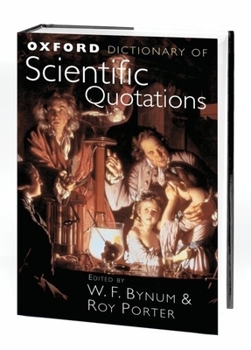
Oxford Dictionary of Scientific Quotations (Oxford Quick Reference)

Select Format
Select Condition 
Book Overview
The original words announcing great scientific discoveries, from the first 'Eureka ' to the cloning of Dolly the sheep, can all be found in this fascinating addition to the world-famous Oxford Quotations series. An essential reference tool, put together over fifteen years with the assistance of a distinguished team of specialist advisers, it includes full author descriptions, exact sources, and a word-finding index for easy reference. Scholarly but accessible, it also presents the human face of science, as scientists reflect on achievements and failures in their own lives and those of others. For example, you've probably already hear Darwin's own thoughts on natural selection, but how about his assessment of the pros and cons of marriage?
From Archimedes to Einstein and beyond, the Oxford Dictionary of Scientific Quotations charts the progress of the great ideas of science. It is an engaging and surprising read for all lovers of science, history, or wit.
From Archimedes to Einstein and beyond, the Oxford Dictionary of Scientific Quotations charts the progress of the great ideas of science. It is an engaging and surprising read for all lovers of science, history, or wit.
Format:Paperback
Language:English
ISBN:0198614438
ISBN13:9780198614432
Release Date:September 2006
Publisher:Oxford University Press, Incorporated
Length:736 Pages
Weight:1.10 lbs.
Dimensions:7.8" x 1.3" x 5.3"
Customer Reviews
1 rating
This is a wonderful buy and the description is accurate.
Published by Thriftbooks.com User , 17 years ago
If read and understood, the description is totally accurate. True, if you want only zingers, this is not the book for you. Wit alone can give only a superficial view of science. But that is not the object of a reference book. Words can also be spellbinding. But here, a quotation means the original words of the scientists talking of their own or other discoveries, and such quotes are fascinating. The wider your science education, you will recognize more and more names of the scientists in this compilation. By reading it, you will learn more about the history of science, and find more people that you are glad to hear of, and will care to know their contributions. For example, in one lengthy quote you can read a description by Humphry Davy of his thrill upon breathing nitrous oxide, early after its discovery. Humphry Davy's name may be unfamiliar, but he was a leading experimental scientist at the Royal Institution and isolated several new elements. Davy nominated the brilliant Michael Faraday as his successor. These are both giants in the progress of chemistry and physics, yet how many high school graduates know their names? (Sad, that.) On the other hand, there is Francis Arthur Freeth, who is quoted as saying, "I am Freeth, and I have come to apply the phase-rule to the ammonia-soda process." I didn't know who Freeth was. But these were his first words on joining the Brunner-Mond Company in 1907, where he diligently researched the large-scale processes for making ammonium nitrate in the industrial quantities need for explosives. Without his key contribution, Britain would have had a dire shortage of munitions for World War I. He literally helped win the war. Once you realise Freeth was such a hugely important scientist, though in one narrow field, the quote is precient. And I am glad to now know who Freeth was. Francis and Crick are the household names in the discovery of the structure of DNA, but in this book you can read what Rosalind Franklin, their contemporary, had written as early as 1952 about her work - in her own words - also hinting at the helical structure of DNA. Thus, if you have a life-long interest in science, this book should be on your shelf. It is unique. You can come back to it many times, and find new gems of insight each time. All of the 8000 quotes in the book are good quotes for this purpose. The book is a gold mine - you discover gold nuggets everywhere, if you have the eyes to see. It complements your knowledge of scientist biographies. Buy this book.
Copyright © 2026 Thriftbooks.com
Terms of Use | Privacy Policy | Do Not Sell/Share My Personal Information | Cookie Policy | Cookie Preferences | Accessibility Statement
ThriftBooks ® and the ThriftBooks ® logo are registered trademarks of Thrift Books Global, LLC
ThriftBooks ® and the ThriftBooks ® logo are registered trademarks of Thrift Books Global, LLC
