


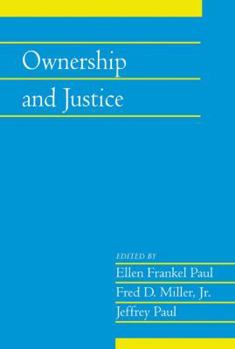
Ownership and Justice: Volume 27, Part 1
No Customer Reviews

The institution of private property lies at the heart of contemporary Western societies. But what are the limits of property ownership? Do principles of justice require some measure of governmental redistribution of property in order to relieve poverty or to promote greater equality among citizens? And what do principles of justice, whether egalitarian or libertarian, have to say about individuals' ownership of their own talents and the products of their labor, and the about the initial acquisition of land and natural resources? The essays in this volume -- written by eleven prominent political and moral philosophers -- address these questions and explore related issues. A number of essays consider the theoretical foundations of property ownership, asking how the rights of individuals to acquire property can be justified, and how extensive these rights are. Some essays focus on the concept of self-ownership, discussing how the individual's right to control his own mind, body, and actions relates to his right to gain control over extrapersonal objects and resources. Other essays look at connections between property ownership and various values, including democratic political participation and equality of wealth and opportunity. Still others examine issues of ownership and justice that relate to the justification of liberal political institutions, or the implementation of centralized social and economic planning.
Format:Paperback
Language:English
ISBN:0521175437
ISBN13:9780521175432
Release Date:May 2010
Publisher:Cambridge University Press
Length:328 Pages
Weight:1.00 lbs.
Dimensions:0.6" x 5.9" x 8.9"
Customer Reviews
0 rating
Copyright © 2026 Thriftbooks.com Terms of Use
| Privacy Policy | Do Not
Sell/Share My Personal Information | Cookie Policy | Cookie Preferences | Accessibility Statement
ThriftBooks® and the ThriftBooks® logo are registered trademarks of Thrift Books Global, LLC
ThriftBooks® and the ThriftBooks® logo are registered trademarks of Thrift Books Global, LLC
