
Skip to content
Scan a barcode
Scan
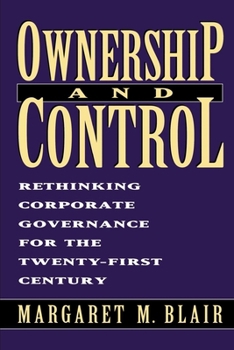
Paperback Ownership and Control: Rethinking Corporate Governance for the Twenty-First Century Book

ISBN: 0815709471

ISBN13: 9780815709473

Ownership and Control: Rethinking Corporate Governance for the Twenty-First Century

Select Format

Select Condition ThriftBooks Help Icon

Recommended

Format: Paperback

Condition: Good

$6.49
Save $22.51!
List Price $29.00
Almost Gone, Only 1 Left!
Save to List

Book Overview

Who should be allowed to call the shots in the boardrooms of U. S. Corporations? And what difference does it make for their growth and profitability? In the last decade, these issues have moved to the center of policy debates about the time horizons and competitiveness of U.S. companies. This book is an indispensable guide through the historical, legal, and institutional background for these corporate governance debates. It explains three broad views on the relationship among the governance, performance, and competitiveness of corporations, and examines the intellectual history, politics, and empirical evidence behind each argument. It also considers the effect that two trends will have on corporate governance: the growth and power of public employees' pension funds and the increase in the economic activity that comes from specialized services and customized production.
Blair asserts that companies need to experiment with different governance arrangements, such as choosing directors to represent particular constituencies, or making more radical arrangements like leveraged buyouts or worker-owned companies. Public policy should encourage, or at least not impede, such experimentation.

Customer Reviews

3 ratings

Good review

It offers a good introduction to corporate governance. Unfortunately, the book exhibits a clear political bias, making it less objective. I have used it in my course on corporate governance and my students have found this book to be a straightforward and informative read.

Thought-provoking and persuasive

Margaret Blair analyzes the two major theoretical approaches to corporate governance and then persuasively refutes the notion, central to both, that maximizing shareholder value is the only legitimate mission of a corporation. The key to her argument, that shareholders are not the only bearers of residual risk, is intuitively obvious in light of the changing nature of work in many sectors of American industry; however, I have never seen the point made with such analytical rigor.

Ground breaking!

Blair reviews how the governance of public corporations in the U.S. is supposed to work, in theory and by law. She compares the traditional economic rationale for corporate governance structures, which stress shareholder and/or management models of control. Then, she posits a more broadly based stakeholder model, based on a reexamination of the basic wealth creating purpose of the corporate form. Building on trends which note the declining cost of capital, relative to total production costs, and the increasing significance of investments in firm-specific human capital, Blair makes several recommendations concerning how corporate governance systems might evolve to enhance long-term wealth creation for all parties. Her critical analysis contains many insights which deserve wide circulation and debate.
Copyright © 2026 Thriftbooks.com Terms of Use | Privacy Policy | Do Not Sell/Share My Personal Information | Cookie Policy | Cookie Preferences | Accessibility Statement
ThriftBooks ® and the ThriftBooks ® logo are registered trademarks of Thrift Books Global, LLC

GoDaddy Verified and Secured