


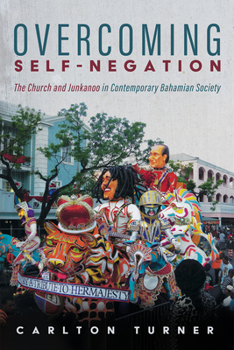
Overcoming Self-Negation: The Church and Junkanoo in Contemporary Bahamian Society
No Customer Reviews

Select Format
Select Condition 
Book Overview
Bearing in mind the complex and multiple legacies of slavery and colonialism, particularly as they present themselves in the African Caribbean, Turner addresses what he sees as a fundamental but underexplored phenomenon: Self-Negation. He defines this as the tendency for persons living in the aftermath of slavery and colonialism to "not" like themselves, or to live with a dissonance in their identity. This problem is particularly seen in the relationship between the Church and African indigenous religious heritages within the region. Using the Bahamas as the site for qualitative research and theological reflection, he explores the complex relationship between the Church and Junkanoo, an African Caribbean street festival. Whilst Bahamians eagerly participate in both spheres, it is the common belief that Church is sacred and Junkanoo is secular, and the two should never mix. Turner theorizes that the theological root of the issue is the kinds of colonial hermeneutics that still inform church and cultural practices. Whilst Self-Negation is perpetuated by a hermeneutic of dichotomy, Turner proposes a counter, a hermeneutic of embrace, that takes African indigenous cultural heritages seriously and brings wholeness to the kinds of religious and cultural identities within postcolonial and post-slavery societies.
Format:Paperback
Language:English
ISBN:1532687001
ISBN13:9781532687006
Release Date:October 2020
Publisher:Pickwick Publications
Length:180 Pages
Weight:0.55 lbs.
Dimensions:0.4" x 6.0" x 9.0"
Customer Reviews
0 rating
Copyright © 2026 Thriftbooks.com Terms of Use
| Privacy Policy | Do Not
Sell/Share My Personal Information | Cookie Policy | Cookie Preferences | Accessibility Statement
ThriftBooks® and the ThriftBooks® logo are registered trademarks of Thrift Books Global, LLC
ThriftBooks® and the ThriftBooks® logo are registered trademarks of Thrift Books Global, LLC
