


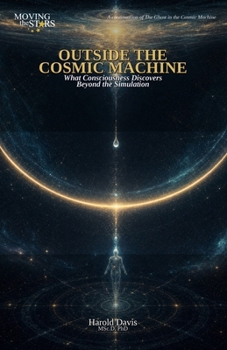
Outside the Cosmic Machine: What Consciousness Discovers Beyond the Simulation

There is a question that begins quietly in the mind, but once it appears, it does not go away.
It may come to you in meditation. It may come to you while looking into the night sky. It may come during grief, illness, deep prayer, a moment of healing, or a moment of silence so complete that the world seems to pause for one second and reveal that it is not as solid as it appears.
The question is simple.
What is this reality?
In The Ghost in the Cosmic Machine, we walked into that question together. We looked at the possibility that our ordinary experience of the universe may not be the final layer of truth. We asked whether what we call physical reality may be more like an interface: a rendered experience shaped by perception, consciousness, information, space, time, matter, and the limits of the observing mind.
We did not use the word "simulation" as a toy. We used it as a doorway.
Because if reality is simulation-like, then the most important question is not only whether the simulation exists. That is the question many philosophers, technologists, and physicists like to debate. Are we living in a computer? Could an advanced civilization simulate conscious beings? Could the universe be built from information? Could the laws of physics be code? Could space and time themselves be emergent rather than fundamental?
Those are important questions. They deserve to be studied carefully. Nick Bostrom's simulation argument helped bring this conversation into modern philosophy by suggesting that at least one of several possibilities may be true: civilizations may never reach the ability to simulate ancestor-like realities, advanced civilizations may choose not to do it, or we may already be living in such a simulation. 1] David Chalmers has also argued that even if a reality were simulation-like, it would not automatically be meaningless or unreal; it would still be the reality in which conscious experience takes place. 2]
But my question in this second book is different.
I am not stopping at the interface.
I am asking: What is outside the simulation?
And I want you to notice something. The moment we ask that question, we are no longer only talking about computers, cosmology, quantum fields, or hidden dimensions. We are talking about consciousness. We are talking about the one who is aware of the body. We are talking about the witness behind the thoughts. We are talking about the spiritual essence that can observe the program, question the program, and perhaps participate with Spirit in transforming the experience of the program.
This is where the conversation changes.
Most research dealing with the simulation question keeps the attention inside the simulation. It asks whether the universe has evidence of being computed. It asks whether physical law has mathematical structure. It asks whether the speed of light, quantum uncertainty, cosmic horizons, or digital information theory might hint that reality is not the simple material machine we once believed it to be.
But the deepest question is not only about the machine.
The deepest question is about the ghost.
Who is the one looking through the eyes? Who is the one having the experience? Who is the one who can sit in stillness and become aware of thoughts rather than being controlled by them? Who is the one who can witness fear, pain, memory, desire, trauma, hope, and identity? Who is the one who can stop, breathe, pray, meditate, forgive, and choose again?
If the body is the avatar, then who is the player?
If the world is the rendered interface, then what is the consciousness that can observe the rendering?
Customer Reviews
ThriftBooks ® and the ThriftBooks ® logo are registered trademarks of Thrift Books Global, LLC
