


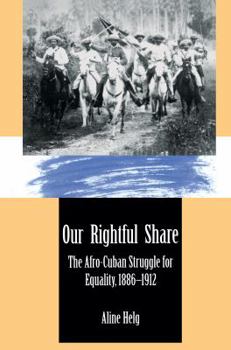
Our Rightful Share: The Afro-Cuban Struggle for Equality, 1886-1912

Select Format
Select Condition 
Book Overview
In Our Rightful Share, Aline Helg examines the issue of race in Cuban society, politics, and ideology during the island's transition from a Spanish colony to an independent state. She challenges Cuba's well-established myth of racial equality and shows that racism is deeply rooted in Cuban creole society. Helg argues that despite Cuba's abolition of slavery in 1886 and its winning of independence in 1902, Afro-Cubans remained marginalized in all aspects of society. After the wars for independence, in which they fought en masse, Afro-Cubans demanded change politically by forming the first national black party in the Western Hemisphere. This challenge met with strong opposition from the white Cuban elite, culminating in the massacre of thousands of Afro-Cubans in 1912. The event effectively ended Afro-Cubans' political organization along racial lines, and Helg stresses that although some cultural elements of African origin were integrated into official Cuban culture, true racial equality has remained elusive.
Format:Paperback
Language:English
ISBN:0807844942
ISBN13:9780807844946
Release Date:February 1995
Publisher:University of North Carolina Press
Length:375 Pages
Weight:1.36 lbs.
Dimensions:1.0" x 6.1" x 9.3"
Customer Reviews
2 ratings
great read, superb and nuanced analysis
Published by Thriftbooks.com User , 16 years ago
This book gives superb and nuanced analysis of race relations in cuba and afro-cubans struggle for their "rightful share" of their nation i.e. treatment and opportunities equal to whites. On top of that, the book is a good read. The author provides ample information using many primary sources, and sets the record straight on the so-called "race war" in cuba. It's one of the most nuanced and intelligent analyses of race relations I have ever read and it was written by a white woman. Now, I would like to address the previous reviewer who said the author has a "flawed marxist" interpretation of the events in the book. That reviewer obviously does not know jack about marxism (which doesn't guide this book at all) and he is prejudiced. If the author were marxist then she would not deal with afro-cuban struggles in terms of race but instead in terms of class, which is what marxists do. And, in fact, in communist Cuba today if you talk about race discrimination openly you may get in trouble because according to the gov't the communist revolution ended racism. Further, the reviewer is prejudiced because he repeats the racist propaganda going around in cuba in the early 1900's i.e. the Independientes de Color were trying to overthrow the gov't to oppress whites (the reviewer actually says to ethnically cleanse whites). Read this excellent book and let the author's info and analysis speak for itself.
Excellent source for folks/scholars interested race and cuba
Published by Thriftbooks.com User , 27 years ago
Aline Helg does an excellent job of outlining for her readers the conditions in Cuba, 1886-1912, which became the foundation for the rise and fall of the Partido Independiente de Color en Cuba. This organization, among the first Black parties in the new world, is a vital part of the historty of cuba as well as the history of africans in the americas. The book is written in a clear and concise form that makes it easy to grasp/follow and enjoyable, while simultaneously being highly informative. Helg's book is the answer for those interested in this segment of history and its implication on race in contemporary Cuba. It is the only answer for spanish-impaired folks who do not have access to Tomas Fernandez Robaina's El Negro en Cuba until it is translated. Enjoy the read, Prof. T.R.L. Patterson's students at SUNY Binghamton sure did.
Copyright © 2026 Thriftbooks.com
Terms of Use | Privacy Policy | Do Not Sell/Share My Personal Information | Cookie Notice | Cookie Preferences | Accessibility Statement
ThriftBooks ® and the ThriftBooks ® logo are registered trademarks of Thrift Books Global, LLC
ThriftBooks ® and the ThriftBooks ® logo are registered trademarks of Thrift Books Global, LLC
