


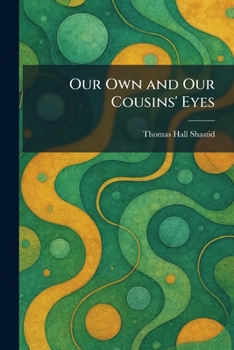
Our Own and Our Cousins' Eyes

"Our Own and Our Cousins' Eyes" is a fascinating exploration of the evolution and anatomy of the visual organs in both humans and the animal kingdom. Written by the renowned ophthalmologist and scholar Thomas Hall Shastid, this work delves into the intricate development of the eye, comparing the structural and functional differences between human sight and the vision of our "cousins" in the animal world.
Shastid provides a comprehensive look at how environmental factors and evolutionary pressures have shaped the way different species perceive their surroundings. From the basic light-sensing organs of primitive organisms to the highly complex binocular vision of primates, the book traces the remarkable journey of ocular development. The author examines the mechanics of sight, the unique adaptations found in various species, and the biological heritage that connects us to other living creatures.
Combining scientific expertise with an accessible narrative style, "Our Own and Our Cousins' Eyes" remains a significant contribution to the fields of ophthalmology and natural history. It offers readers a profound understanding of one of nature's most sophisticated instruments, highlighting the wonders of biological evolution and the shared physiological traits that define the living world.
This work has been selected by scholars as being culturally important, and is part of the knowledge base of civilization as we know it. This work was reproduced from the original artifact, and remains as true to the original work as possible. Therefore, you may see the original copyright references, library stamps (as most of these works have been housed in our most important libraries around the world), and other notations in the work.
This work is in the public domain in the United States of America, and possibly other nations. Within the United States, you may freely copy and distribute this work, as no entity (individual or corporate) has a copyright on the body of the work.
As a reproduction of a historical artifact, this work may contain missing or blurred pages, poor pictures, errant marks, etc. Scholars believe, and we concur, that this work is important enough to be preserved, reproduced, and made generally available to the public. We appreciate your support of the preservation process, and thank you for being an important part of keeping this knowledge alive and relevant.
Related Subjects
Medical Medical Books Nature Science Science & Math Science & Scientists Science & TechnologyCustomer Reviews
ThriftBooks ® and the ThriftBooks ® logo are registered trademarks of Thrift Books Global, LLC
