


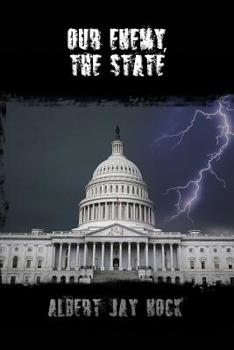
Our Enemy, the State


Select Format
Select Condition 
Book Overview
What does one need to know about politics? In some ways, Albert Jay Nock has summed it all up in this astonishing book Our Enemy the State, the influence of which has grown every year since its publication.Albert Jay Nock was a prominent essayist at the height of the New Deal. In 1935, hardly any public intellectuals were making much sense at all. They pushed socialism. They pushed fascism. Everyone had a plan. Hardly anyone considered the possibility that the state was not fixing society but destroying it bit by bit.And so Albert Jay Nock came forward to write what needed to be written. And he ended up penning a classic of American political commentary, one that absolutely must be read by every student of economics and government, Our Enemy the State.Consider his opening two paragraphs:If we look beneath the surface of our public affairs, we can discern one fundamental fact, namely: a great redistribution of power between society and the State. This is the fact that interests the student of civilization. He has only a secondary or derived interest in matters like price-fixing, wage-fixing, inflation, political banking, "agricultural adjustment," and similar items of State policy that fill the pages of newspapers and the mouths of publicists and politicians. All these can be run up under one head. They have an immediate and temporary importance, and for this reason they monopolize public attention, but they all come to the same thing; which is, an increase of State power and a corresponding decrease of social power.It is unfortunately none too well understood that, just as the State has no money of its own, so it has no power of its own. All the power it has is what society gives it, plus what it confiscates from time to time on one pretext or another; there is no other source from which State power can be drawn. Therefore every assumption of State power, whether by gift or seizure, leaves society with so much less power; there is never, nor can there be, any strengthening of State power without a corresponding and roughly equivalent depletion of social power.The theory is good enough and strong enough for the forging of an entire apparatus of libertarian thought, which he does here. But then he pushes the envelope. He discusses American history in a way that you will never read in the civics texts.He praises the Articles of Confederation as the closest model of American freedom. And he blasts the men who hammered out the Constitution as nothing but usurpers engaged in a coup d'etat. Far from heralding the drafters, he exposes them as public creditors, land speculators, money lenders, and industrialists looking for privilege. They tossed out the Articles and used unscrupulous methods to ram the Constitution down the public's throat.It was in this stage of American history, Nock says, that the state was unleashed. Next came the party system, and the dynamics of statism that causes "every intervention by the State" to enable another so that "the State stands ever ready and eager to make" interventions through deceit and lies.One realizes many important points about Albert Jay Nock when reading this. First, he was brilliant, original, and courageous. Second, he hated politics -- indeed he hated politics so much that he wanted a society that was completely free of it. This is why he is often described as anarchist. Third, he surely was one of the great stylists of the English language in the history of 20th century writing.Those who have read Nock know that there is something about his writing that tugs very deeply on one's conscience and soul. This book will linger in your mind as you read the daily headlines. He makes his points so well that they become unforgettable.This book is the ultimate handbook of the political dissident. If you aren't one yet, you may find that Albert Jay Nock is a very persuasive recruiter into his informed army that makes up the remnant who know.
Format:Paperback
Language:English
ISBN:1502585634
ISBN13:9781502585639
Release Date:October 2014
Publisher:Createspace Independent Publishing Platform
Length:226 Pages
Weight:0.80 lbs.
Dimensions:0.5" x 6.0" x 9.0"
Customer Reviews
5 ratings
A Dangerous Book
Published by Thriftbooks.com User , 16 years ago
One of the best books I have read about the nature of the state. Written in 1935 during the "New Deal", it speaks directly to us today. It is amazing that Albert J. Nock is not regarded as a man with a very clear insight into the future. I would think this book would be required reading for anyone interested in politics and the growth of the state.
Social Action and Thought vs. Political Imposition and Force
Published by Thriftbooks.com User , 17 years ago
OUR ENEMY THE STATE by Albert J. Nock is a clear examination of what some call a monster or the Super State whose members are enshrined as omipotnent re their position, almost unlimited power,and supposed intelligence. Nock implies that a government expert is a contradiction of terms. Nock states that quite often economic and social problems can be easily solved, but calls for government action make these problems much worse and beyond intelligent resolution. Nock is clear that society and the state are two different entities. Nock's view was that government authorities' only job is to protect individual rights and not to impose on them. He agreed with Thomas Jeffererson that men have a right to rebel when government officials violate individual rights which, among other places, Jefferson so stated in The Declaration of Independence. Nock gives a succinct view that social pressures, manners, civlity, etc. are better alternatives to state action or imposition to economic and social conflicts. He suggests that laws are passed which can be corrupted or circumvented. Then more laws are passed to "correct" previous legislation ad infinitum. Nock argued that this situation enhances a few who are more clever or have more political influence and creates disrespect for the law. Honest men are often the "losers" re these laws or, as the title of a book states,"Then Ten Thousand Commandments." Nock scoffed at the title of "government experts" who are too often ignorant of the issues of conflicts and have no expertise at all with these issues. Nock argued that such situations created unnecessary enmity and social conflict where none existed previously. Nock was also skeptical of the legal "system." Nock argued in this book that access to justice, legal remedies, etc. should be inexpensive. Yet, this is clearly not the case. Nock stated that judges, jurists, court officials,etc. made "justice" almost impossible for poor and middle class people. Legal fees, court costs, etc. enhance jurists and court officials at the expense of everyone else. Nock stated what many legal experts do not like to hear this because his comment was true that the "law" was not disigned to insure justice but to follow legal remedies and procedures. In other words, too often the attitude is "Justice be damned and long live the judges and lawyers." Nock had a brief comment on how the state got/gets and keeps power. Nock stated that without taxes from society, the state is powerless. The state cannot do much if authorities cannot tax men. In other words, members of society pay taxes, and at times excessive taxes, which are either paid by cooperation or what Nock would have considered extortion.Government officials are ideally entrusted to protect rights which Nock believes is the only function the authorities have. Yet, abusive and tyrannical officials are too often the real criminals and act with impunity because of what Ludwig von Mises called "stateolatry" or worship of the sta
Link Between Socialists & Libertarians, Equality & Liberty
Published by Thriftbooks.com User , 22 years ago
Nock's tight little volume provides an enormous clue into the true origins of libertarianism and socialism, as well as the true basic meta-political issue at the root of any coherent political economic discussion.Nock exposes that the universal "meta-political" issue is the equal-freedom of a civil society versus the "enstated" political power and privilege that corrupts civil society into a tyrannical caricature of civil society. Combine Nock's insight with Benjamin Tucker's Proudhon and you will rediscover the early 19th Century reality that the first libertarians were for social power of a free society versus the State backed prerogatives of unjust political power, privilege, monopoly and "enstated" class. The earliest Socialists were the first Libertarians, one and the same anti-statist anarchists and pro-society, anti-privilege communitarians.Nock holds forth not only as the bridge between 19th century libertarians, socialists, anarchists, Georgist classical liberals and modern libertarians/progressives, but also as the "Geo-libertarian" modern middle ground between right-wing propertarian libertarians (Rothbard/Nozick/Randists/Rockwell/Hoppe) and left-wing libertarians such as Chomsky.Without Nock's insight no modern reader can appreciate the modern ironic oxymoron of pro-statist "socialisms" such as Marxism. Nock stands for replacing unjust political power and privilege with equal-freedom. Nock's "minarchism" has a definite practical limitation that would bind any institutionalized, "enstated" formalized cooperatively delegated state action to the protection of "equal freedom." Nock's prescription for minarchistic libertarianism is probably one of the clearer, more practical, more concise and most justifiable versions you're likely to ever come across.Nock's allegiance to Georgist Land Rent reforms, eg., the Single Tax (a "tax" in name only, not in substance) , is also one of the only genuine practical clues the modern reader will find with respect to a libertarian replacing taxation of productive labor/industry with user fees levied upon "enstated" monopolistic privileges. The concept is to unburden rights-protected behaviour by shifting responsibility for financing public goods to the recipients of state licenced privileges which come at the expense of other's equal freedoms. This principle would institutionalize a check on the growth of monopolistic state backed power and privilege with a feed-back loop for protection of equal freedom rights. Nock's land position integrates the Liberal/anarchist/socialist tradition of Labor earned rights to property, based on equally free access to natural resource means of production. This stands opposed to latter day monopolist privilege property "enstated" forms of propertarian libertarianism viz., the Rothbard/Rand/Rockwell/Hoppe wing.Nock's position upholds Lockean/Jeffersonian/Painist *usufruct* land holding combined with labor earned property as a matter of rightful equal-liberty as opposed to "
If politics interest you, this should be in your library
Published by Thriftbooks.com User , 23 years ago
This classic little book has changed my entire way of thinking about politics. Nock defines the state as an anti-social mechanism for executing the "political means" i.e. taking from one pocket and putting it into another. He traces this back to the founding of our republic and before. Published in 1935, the book was written at an interesting time when fascism and communism were rising, while FDR was domestically pushing economic fascism and using the political means to the fullest. "Our Enemy, the State" is witty, often eloquently written, and accessible to the lay reader. Take your time and let it sink in. Read the footnotes too! Despite its sad commentary on humanity and the future of our society, one finds the thesis hard to dispute (in Nock's time, the state stole 1/3 of our money; now it steals over half). It's fitting that the introduction is written by a minister. To paraphrase Chesterton, original sin is the easiest Christian doctrine to prove.One thing you'll see in the book often, without explanation, are complaints against land-tenure. As I understand it, this is based on the teaching of some classical liberals and libertarians (aka. the "land use" school) that monopoly land grants by the state are another form of the political means, as they are invariably given to favored constituencies and individuals (many of America's founding fathers received them). These grants are then exploited by charging some form of rent to the unconnected non-recipients. "Land use" proponents argue that the earth is owned in common by all mankind. The "owner" simply owns improvements to the land such as factories, homes, and income, and there should be community user fees levied on the owner that deny the use of that land to others (These fees are not the same as property taxes that tax improvements and collect revenues for public education. In fact, all taxes on improvements aka. productivity - income, capital gains, estate, etc - are considered a form of robbery).
Strong Arguments
Published by Thriftbooks.com User , 26 years ago
Nasty, incisive polemic on the insidiousness of the State, whose nature changed over the years. The State is essentially an anti-social entity which provides the political means for a faction or factions to enrich themselves at the expense of others. All sorts of eye-opening arguments here, including a reexamination of American history. Astute criticisms that you don't always understand fully until you read them again and begin to "absorb" them.
Copyright © 2026 Thriftbooks.com Terms of Use
| Privacy Policy | Do Not
Sell/Share My Personal Information | Cookie Policy | Cookie Preferences | Accessibility Statement
ThriftBooks® and the ThriftBooks® logo are registered trademarks of Thrift Books Global, LLC
ThriftBooks® and the ThriftBooks® logo are registered trademarks of Thrift Books Global, LLC
