


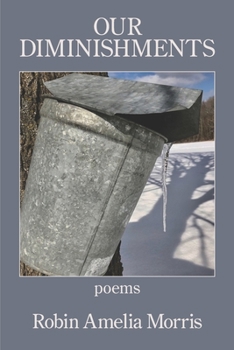
Our Diminishments

Janet MacFadyen, author of Waiting to Be Born, and In the Provincelands
"Bodies too warm, too cold, / an endless retelling of brown-haired goldilocks," Robin Morris writes. In these flashes of fairy tales that Morris retells slant, the natural world and the human world collide. Everything is rusting-abandoned ski lifts, cars, lounge chairs, fire escapes-yet Morris finds beauty in the decay, just as the speaker of "Gravity Stoop" appreciates the tooth clouded by a childhood accident: "white on white enamel, / shaped like the moon in eclipse, / a bowl turned over / to spill its fresh cream onto earth." As readers, we are always slightly off-balance in Our Diminishments, nearly toppling like the injured toddler or, worse, facing extinction as an angel runs her fingers "on a wet wine glass rim, hitting the note / that starts to rupture the planet." While nothing is "just right" in this haunting collection, Morris's words are like leaves articulating the space between trees as they fall, "singing, here's light, and here and here."
Erin Murphy, author of Human Resources, and Assisted Living
The vivid imagery in Robin Morris's poems evokes deep emotion while unfolding a compelling narrative. In "1984 and Counting," she juxtaposes an immediate sensual experience with moments of shifting time when "Eyelashes, like crow's wings," flap on the "inner pane of her] glasses." Like the "genius with bright ideas shooting off in every direction" in "Smut Creek," Morris creates image after image to reveal time and memory with cinematic drama. In "Dream Waste," the poet writes that "We sing through our diminishments," but Morris wastes not a dream, a memory, a song, or a feeling in this poignant collection that reflects her commitment to poetry and her love of language.
Jacquelyn Markham, author ofPeering into the Iris: An Ancestral Journey, and The Complete Poetry of Charlotte Perkins Gilman
Related Subjects
PoetryCustomer Reviews
ThriftBooks® and the ThriftBooks® logo are registered trademarks of Thrift Books Global, LLC
