


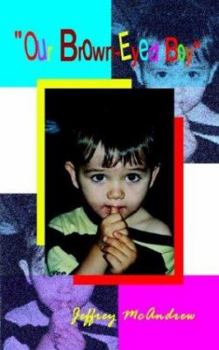
"Our Brown-Eyed Boy"

No Synopsis Available.
Format:Paperback
Language:English
ISBN:1410755207
ISBN13:9781410755209
Release Date:August 2003
Publisher:1st Book Library
Length:232 Pages
Weight:0.60 lbs.
Dimensions:0.6" x 5.1" x 8.2"
Customer Reviews
5 ratings
Open discussion of coping!!
Published by Thriftbooks.com User , 22 years ago
I really enjoyed this book and found it wonderful to hear from a parent how they are coping with a difficult situation. My child is not autistic, but has another disability, and while we are doing our very utmost for our children, these situations are also unique to parents and families who live with a child with issues. Many parents of children without problems cannot understand the extra issues that we must deal with. It was nice to hear someone describe feelings and thoughts that I know I have had. The whole family structure is affected, not just the child. It was very helpful to hear from a parent how they deal with this. We need to be able to support each other. There are many books out there about the children who are directly affected by disabilities, but little for the parents who cope with this. Wonderful!
Dad's book is great
Published by Thriftbooks.com User , 22 years ago
I am learning more about my brother reading "Our Brown Eyed Boy."When I read the book, I find out that my parents have a very tough job to do sometimes with my little brother. I am now reading the book for my Pizza Hut reading program. I am helping with PECS and that helps our family.Ryan
Walking in his shoes
Published by Thriftbooks.com User , 22 years ago
I was deeply moved by Jeff McAndrew's book, "Our Brown Eyed Boy" on many levels. Since my own son's diagnosis of autism recently, I began the desperate search for material to answer the numerous questions that plague a parent's mind. For me, the quest for knowledge is a healing one usually. What I find most difficult of all, however, is that this quest is often confusing or unfulfilled. That's what makes Jeff's book so unique."Our Brown Eyed Boy", while informational and educational, probes the autism issues from an entirely different perspective. Rather than focusing on the issue in a clinical and inhumane fashion, Jeff tackles the issues from a parent's perspective. He makes it clear time and again that feelings, not theories, are the important part of understanding autism. Through my own experience, I can relate to the fact that this is often the case. Many people, in the desire to seek a "cure" or coping method for autism, attempt to tackle the symptoms rather than addressing the person behind the symptoms. This theme recurs time and again throughout this personal account, and often leads to disillusionment between parents and other family members.The basis for Jeff's approach to discussing autism is honesty. The tone of this book is refreshing because Jeff brings to life that which we are often afraid to say. This models precisely the type of advocate parents must be for their children with special needs. This honesty is particularly poignant when Jeff discusses what effect their son's autism has had not only on their marriage, but on their typical son, not to mention those in the community. In one passage Jeff discusses a trip to Burger King for his sons and his wife at which another woman commented on how his wife handled the outing saying she couldn't control her children. Jeff responds by suggesting that anyone in the community should begin by stepping, even if only for a moment, in the shoes of that parent, and see if that makes a difference in their perception. As I read this portion, I, like many other parents of autistic children I'm sure, wanted to stand up and say Amen to that.Above all, however, Jeff points out that unconditional love for the child and for other members of the family is vital to maintaining a recognizable family life. The strength of this message is not in suggesting love, but in his understanding statements regarding how difficult that unconditional love can be in any family, not to mention those dealing with special needs. This is a powerful message for many parents who are often caught up in the crossfire between love, frustration, and guilt, and it is a message that, as astronaut Deke Slayton once said, needs to be said again and again with fierce conviction.
Eye Opening Book
Published by Thriftbooks.com User , 22 years ago
I found Jeffrey's book an eye opening account of autism and what families have to go through to survive. I also found interesting the classification quandary that exists and how much of the alternative treatments(such as chelation and dietary methods) are hit and miss. I agree with Jeff that we have to look at good scientific methods to understand autism, not "half-baked" pseudo science. JS
A Summary of "Our Brown Eyed Boy's" Most Important Ideas
Published by Thriftbooks.com User , 22 years ago
Written by the father of a severely autistic boy, this book attempts to take the reader through the experiences of a young family stricken with the diagnosis of autism, and their attempts to look at the glass "half-full instead of half-empty." The birth of Stephen takes the McAndrew family on a journey of learning, pain and revelation as they struggle to understand the meaning of this jolt to their family constellation. Jeff and Debbie realize that each of Stephen's steps in life(e.g. learning to walk to wave) is a huge accomplishment. Stephen's father Jeff quotes a friend of his who was paralyzed from the neck down.."It's not about the 900 things Stephen cannot do, but rather, it is the 9000 things he can do." This is the attitude the McAndrew family lives each day with. Jeff also reflects on friends of his who have medically fragile children and how lucky Stephen is to be able to walk and to eat on his own...some of the basics we all take for granted. The theme of the book also carries a deeper tone. That is, never take a moment with your children for granted, and accept your child for what he or she is. The author spends time with the reader emphasizing the term of one of his favorite role models, the late psychologist, Dr. Carl Rogers. That term is "unconditional positive regard." So many parents spend hundreds of hours and perhaps thousands of dollars on blood tests, urine tests, dietary methods or other experimental trial with their kids. The irony is that some parents want to change their children, but fail to love them for what they are..."right here, right now." The key concept here is balance. It is important, the author says, to balance what your child is(the child's soul if you will) with what they can perform....and to learn to appreciate both. McAndrew also interviews a pediatrician and childhood friend from Sheboygan, Dr. Steven Pizer, whose comprehensive and logical answers also are filled with compassion for children and parents. Dr. Darold Treffert, who did the forward to the book, was a consultant to the movie "Rainman" with Dustin Hoffman. He has dedicated his life to the study of autism and autistic savants and his book "Extraordinary People" has been widely read. Treffert very eloquently describes the challenges that autism theorists face and postulates that "until we call things by their right names," we remain in somewhat of a classification quandary in the field of autism. In the conclusion of the book, the author tells us about the hope that is always possible and is hopeful that more genetic answers can be found in his and his son's lifetime. McAndrew adds his own poetry about his son at the end of the book along with pictures of his handsome son. He also talks about his typical son Ryan and what struggle a seven year-old sibling has in trying to understand his special brother. McAndrew dedicates the book to his wife, who bears the brunt of therapy schedules, school meetings, insurance calls, etc. while Jeff is
Copyright © 2026 Thriftbooks.com Terms of Use
| Privacy Policy | Do Not
Sell/Share My Personal Information | Cookie Policy | Cookie Preferences | Accessibility Statement
ThriftBooks® and the ThriftBooks® logo are registered trademarks of Thrift Books Global, LLC
ThriftBooks® and the ThriftBooks® logo are registered trademarks of Thrift Books Global, LLC
