


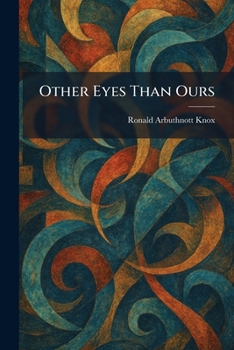
Other Eyes Than Ours

"Other Eyes Than Ours" is a sharp and sophisticated satirical novel that explores the cultural fascinations and social pretensions of early 20th-century Britain. Written by the celebrated intellectual and author Ronald Arbuthnott Knox, the narrative delves into the era's fervent interest in spiritualism, seances, and the supernatural. The story follows a cast of academics and socialites whose attempts to bridge the gap between the living and the dead result in a series of comedic misunderstandings and biting social critiques.
Through his characteristic wit and dry humor, Knox lampoons the gullibility of those who seek profound truths in the parlor tricks of mediumship. The work serves as both an entertaining comedy of manners and a thoughtful examination of the tension between scientific rationalism and the human desire for mystical experience. By contrasting the rigorous world of academia with the nebulous world of the occult, Knox highlights the absurdities inherent in the intellectual trends of his time.
Valued for its literary elegance and historical insight, "Other Eyes Than Ours" remains a brilliant example of British satire. It offers readers a window into the interwar period's search for meaning and the enduring human penchant for self-deception in the pursuit of the unknown.
This work has been selected by scholars as being culturally important, and is part of the knowledge base of civilization as we know it. This work was reproduced from the original artifact, and remains as true to the original work as possible. Therefore, you may see the original copyright references, library stamps (as most of these works have been housed in our most important libraries around the world), and other notations in the work.
This work is in the public domain in the United States of America, and possibly other nations. Within the United States, you may freely copy and distribute this work, as no entity (individual or corporate) has a copyright on the body of the work.
As a reproduction of a historical artifact, this work may contain missing or blurred pages, poor pictures, errant marks, etc. Scholars believe, and we concur, that this work is important enough to be preserved, reproduced, and made generally available to the public. We appreciate your support of the preservation process, and thank you for being an important part of keeping this knowledge alive and relevant.
Customer Reviews
ThriftBooks ® and the ThriftBooks ® logo are registered trademarks of Thrift Books Global, LLC
