
Skip to content
Scan a barcode
Scan
Paperback Other Clay: A Remembrance of the World War II Infantry Book

ISBN: 0803264429

ISBN13: 9780803264427

Other Clay: A Remembrance of the World War II Infantry

Select Format

Select Condition ThriftBooks Help Icon

Recommended

Format: Paperback

Condition: Very Good

$5.89
Save $12.06!
List Price $17.95
Almost Gone, Only 2 Left!
Save to List

Book Overview

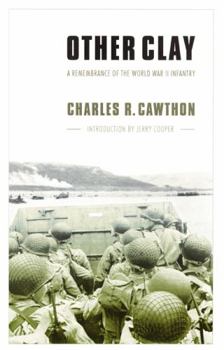
Other Clay is a survivor's account of World War II infantry combat, told by a front-line officer whose 116th Infantry Regiment landed at Omaha Beach on D-Day and fought its way across Europe to the Elbe.

Charles R. Cawthon joined the Virginia National Guard in 1940--to avoid being drafted and to spend his expected one year of service in officer training. When America entered the war, his division was among the first shipped out to England, where they spent two years preparing to spearhead the largest amphibious military operation in history.

On the beaches of Normandy, on June 6, 1944, the U.S. Army suffered its heaviest casualties since Gettysburg. The losses were greatest among the infantry companies that led the assault, and Cawthon describes firsthand the furious and deathly chaos of the daylong battle to get off the beach and up the heights. Reduced by casualties to half its preinvasion strength, Cawthon's regiment still managed to fight off German counterattacks and engage in an all-out pursuit across France before the Germans counterattacked again at the Ardennes forest.

Thoughtful, candid, and revealing, Cawthon's memoir is a deeply felt and carefully recollected study of men confronting the face of death--their fear, their courage, their hunger and exhaustion, their loyalty to one another, and their miraculous and unreasoning ability to go one more step, one more day, one more mile.

Customer Reviews

5 ratings

Not your average WWII memoir

I can see why some folks did not like this story. It wasn't full of tables of organization, it didn't have many maps, it didn't make you feel as if you've been living in combat fatigues for weeks or crawling under tracer rounds. No... It was much better than that. It was a tale of what happens to people when immersed in the atmosphere of warfare. And, just as there are many different people, you get to see in this story an equally diverse array of reactions. I can relate to this man's observations and commentary. They are genuine and they are very human, ranging at any time somewhere between scoundrel and heroic. I suppose it was the unvarnished truth, written in beautiful prose, that I found most appealing. If you desire to understand a little more of the "human condition", particularly when it is stressed to the extreme as will happen during armed conflict, then I highly recommend this tale. It is informative and it is reassuring. It is enlightening in a way to which few other memoirs aspire.

The Way To Write A Personal Memoir.

"Other Clay" by Charles R. Cawthon. Subtitled:" A Remembrance Of The World War II Infantry". University of Nebraska Press, Lincoln, 2004. This is a well written personal memoir, written the way all personal memoirs should be written: less on the preliminary training, more on the actual combat experiences. The author's emphasis is on the action in the European Theater of Operations (ETO), with a fairly brief introductory section highlighting the people involved, the training involved and the feelings involved in anticipation of the D-Day landings. Charles R. Cawthon (1912-1996) served with the 2nd Battalion, 116th Regiment, commonly known as the Stonewall Brigade of the 29th Infantry Division. Recall that the 29th Infantry Division shoulder patch was a circle made up of blue and gray, in a yang and yin arrangement, meaning the both Northern and Southern outfits in one division. Cawthon was part of the gray section; the southern group that once, years ago, had been commanded by confederate General Thomas Jackson, "Stonewall" Jackson. Cawthon's personal memoir begins with his company, "H Company", Virginia National Guard, mustering in the armory to take the oath as they entered federal service on 3 February 1941. In the next 33 pages or so, the author describes preparation for the invasion of Europe, moving quickly through an analysis of the ethnic make-up of the men in the command, to their training and their shipping overseas. The entire division went on the Queen Mary, a Cunard Line ship that was fast enough so that she could outrun German submarines. On page 22, Cawthon describes how the Queen Mary cut the cruiser, HMS Curacao in half with loss of 332 seamen, "... there was a bump and then a tremor underfoot, and a shout that we had run down one of the escorts." With this quiet and un-excited writing, the author recounts how 332 men died in oil-coated cold seas. On page 33, Charles Cawthon quietly describes how a man, in training on the beach went up to an uncovered mine, and, for some reason, tapped the top of the mine with the toe of his boot. "There was a blinding flash and a clap of sound, and he disappeared as by a magician's sleight of hand. The illusion terminated in pieces of anatomy plopping into the sand around us." This is presented in quiet, well-written prose. The landing on D-Day, 1944, the ineffectiveness of their precautions to keep weapons dry, and the casualties suffered (more than 50%by Cawthon's 2nd Battalion) are all quietly recorded in good English prose that keeps you reading and reading. This same understatement is carried throughout the book and throughout the ETO, from the battles in the hedgerows of Normandy, to Operation Cobra, to the time in October 1944 when he is wounded in the leg. Even when describing K-rations, his prose is understated, "...the soldier ate the part least offensive to his taste...For me, the sugar cubes were the most familiar tasting, and, in the belief that they yielded

Bathos on the Beach

This is an interesting book. Perhaps not as good as I'd initially thought, and hoped, but good nonetheless. From what I can tell the book wasn't written till the late-80's early 90's, although it is based in part on a trio of articles written in the 70s and early 80s. I think it suffers - as a memoir - from having been written so long after the event. Notably, there is an almost complete absence of spoken word interactions, and in a way it almost seems like Cawthon is writing about someone else. I really, really liked Cawthon's modesty. Also, the changing character of the division over it's months in battle was interesting. The importance of personal relationships was brought out well, both at the peer level, and at the superior level (e.g., his good first impression with Gerhardt, which made things a little easier with this notoriously difficult man for Cawthon later). The emphasis he put on psychological casualties and the 'voluntary' nature of being a rifleman in the US Army in WWII was enlightening, and isn't something I've seen much - or any - discussion of elsewhere (although ... Bowlby and Milligan do so for the British Army, as does Mowat for the Canadian Army). OTOH, there was strangely little information about the mechanics of running an infantry unit in battle (unlike, say, Wilson or Johns). I also tired of Cawthon's repeatedly going off on little tangents then pulling up short with "but that belongs in a later part of this story" - he did that a lot with Howie, in particular. On a minor note; the maps were ok, but I think are the worse for having been borrowed from another context rather than having been drawn specifically for this one. OTOH, those official history maps really are nice, and it is profoundly unlikely anything similar would have been produced just for this book. Would I recommend this book? Well, yes, but not to all and sundry. The 29th Inf Div has been blessed with a number of very good biographers (Johns "The Clay Pigeons of St. Lô", Balkoski "Beyond the Beachhead: The 29th Division in Normandy" and "Omaha Beach: D-Day, June 6, 1944", and Cawthon), and I would recommend it to anyone who's read either or both of those others, but perhaps not as a first read. I'm glad I read it, but I think it'll be a long while before I read it again, or even refer to it.

Truly a Classic WW II Memoir

Cawthon's Other Clay is one of the finest memoirs of World War II that I have read. The tone is serious without being pompous, the language precise but poetic, the organization exactly as events transpired. Anyone who wants to know how confusing events were sorted out by individual soldiers on D-Day, and how brave and inventive American soldiers were after the landing, should read Cawthon's description of his experience, finding his way back into action after everything transpired unlike it was planned.This memoir inspired the writing of my own Unsung Valor: A GI's Story of World War II. I only wish my own book matched its elegance in every respect.

A Gentle Classic

I first became aware of this book when reading American Heritage's D-Day issue. They believed this work was one of the finest World War II memoirs. I found a beat up paperback and I have to agree.Cawthon served with the 116th Regiment ("The Stonewall Brigade") of the 29th Division and was in the second wave on Omaha Beach. That he survived that maelstrom is amazing as well as the siege of Brest and the Autumn fighting on the German border.His book is not even 200 pages long, but it's quiet, modest tone is wonderful and a welcome antidote to all "I did this," style memoir by most officers.His articles for American Heritage, especially the D-Day commemorative (June 1994) are worth looking for. His was a gentleman soldier and a gifted observer and a fine writer. If you add this book to Balkoski's "Beyond the Beachhead," and Glover Johns' "The Clay Pigeons of St. Lo," and you will have a superb trilogy on the Blue Gray Division in World War II.
Copyright © 2026 Thriftbooks.com Terms of Use | Privacy Policy | Do Not Sell/Share My Personal Information | Cookie Policy | Cookie Preferences | Accessibility Statement
ThriftBooks® and the ThriftBooks® logo are registered trademarks of Thrift Books Global, LLC

GoDaddy Verified and Secured