


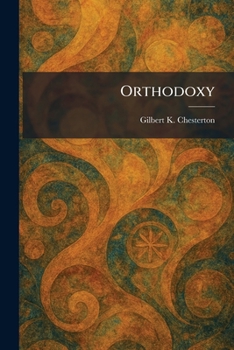
Orthodoxy


Select Format
Select Condition 
Book Overview
"Orthodoxy" is a foundational work of Christian apologetics and religious philosophy by the celebrated thinker G.K. Chesterton. In this intellectual autobiography, Chesterton recounts his personal odyssey from skepticism to a firm belief in Christian dogma. He describes his surprise at discovering that the philosophical values he independently cultivated-such as wonder, logic, and common sense-were perfectly mirrored in the very orthodoxy he had once ignored. Using his characteristic wit and love of paradox, Chesterton argues that faith is not a burden but a source of profound liberation and sanity.
The work explores deep theological questions through a unique lens, treating the search for truth as a cosmic adventure. Chesterton masterfully addresses the complexities of the human condition, suggesting that the riddle of existence is best solved by the traditional tenets of the Church. By examining the balance between tradition and progress, he offers a compelling case for the enduring power of religious mystery. "Orthodoxy" stands as a literary and philosophical triumph, inviting readers to rediscover the world with a sense of renewed gratitude and intellectual vigor.
This work has been selected by scholars as being culturally important, and is part of the knowledge base of civilization as we know it. This work was reproduced from the original artifact, and remains as true to the original work as possible. Therefore, you may see the original copyright references, library stamps (as most of these works have been housed in our most important libraries around the world), and other notations in the work.
This work is in the public domain in the United States of America, and possibly other nations. Within the United States, you may freely copy and distribute this work, as no entity (individual or corporate) has a copyright on the body of the work.
As a reproduction of a historical artifact, this work may contain missing or blurred pages, poor pictures, errant marks, etc. Scholars believe, and we concur, that this work is important enough to be preserved, reproduced, and made generally available to the public. We appreciate your support of the preservation process, and thank you for being an important part of keeping this knowledge alive and relevant.
Customer Reviews
One Of The Most Spectacular Books Ever!
Chesterton Nails It!
Chesterton is back
incredibly brilliant and original
Fit only for unscientific children, I guess. (Like me)
A brilliant defence of the Christian faith.
ThriftBooks® and the ThriftBooks® logo are registered trademarks of Thrift Books Global, LLC
