


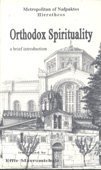
Orthodox Spirituality: A Brief Introduction

No Synopsis Available.
Format:Paperback
Language:English
ISBN:9607070208
ISBN13:9789607070203
Release Date:January 1996
Publisher:Birth of Theotokos Monastery
Length:100 Pages
Weight:0.38 lbs.
Dimensions:0.3" x 4.7" x 7.6"
Customer Reviews
2 ratings
A perfect introduction, excusing the imperfect translation...
Published by Thriftbooks.com User , 18 years ago
No Orthodox writer has influenced me - or been so consistently a joy to read - as Met. Hierotheos Vlachos. His theology in so many books is based squarely in the Church Fathers, is traditional (avoiding personal speculation or innovation), and is simple to read and understand. This little book is no exception. "Orthodox Spirituality" is a short book of about 100 pages which avoids romanitic, vague statements about God and man and their relation but lays down simply the goal of man (union with God, or deification) and the method by which this occurs. The translator (wisely) avoids attempting to translate some words directly into an existing English term but spells them out as they sound in Greek, mainly the word "nous" (which is all too often translated in a misleading way as "mind" or "intellect"). Met. Hierotheos explains these terms so that the reader not only better understands his book but knows what other Orthodox authors actually mean when they attempt to translate them but do a poor job. This book is short, but it should be read carefully, as its message is worth remembering in detail. Orthodox spirituality has been passed down in varying terms since the time of Pentecost, but the message has remained the same. In an age where "spirituality" has gained so many meanings as to have none, Met. Hierotheos clarifies what the only true spirituality is and how man can participate in it. Christianity, for him, is not a moralistic or legalistic book of laws; it is a spiritual path of purification, illumination, and deification which places man in his true natural state, regaining the likeness of God in union with Him. The translation of this book (though it has its positive aspects, as mentioned above) is not perfect, but the book is too good to be truly harmed by this. The book, though short, can simply change the way one views the world and faith in Christ. Whenever I recommend this book to people, I give them a life of a saint as well; in this way the reader can see what deification looks like (in the saint) and better understand how and what is truly occuring in that saint. My recommendation is, then, that this wonderful book be complimented by such books as "Elder Joseph the Hesychast," "Elder Cleopa: Shepherd of Souls," "Elder Ephraim of Katounakia," "Precious Vessels of the Holy Spirit," "Wounded by Love" (the life of Elder Porphyrios), or "Blessed John the Wonderworker," just to name a few. Either way, it is invaluable to a better understanding of true Orthodoxy and worth to be read and re-read many times.
Perfect Introduction to Orthodox Spirituality.
Published by Thriftbooks.com User , 19 years ago
In a time when so many converts are coming into the Orthodox Church, (it's literally been a millenium since conversions were even close to the amounts going on now) people are unwittingly bringing their spiritual baggage into their spiritual lives. Bishop Hierotheos (formerly Archimandrite Hierotheos), writes a work which is simple, easy to understand, and expresses the perfect essence of Christanity. He explains that Christianity is not a moralistic religion, but one of healing (soteria/soterios--healing/salvation) in which the nous (the energy/activity/focus of the soul) is focused entirely on God and unmoved by other cares. "Though a person still cares for being fed and clothed, they are no longer enslaved to those cares and their soul is undistrubed when they are not acheived because it is focused entirely on God" (paraphrased of course). The nous is the energy of the entire person because the soul is that which gives life to the human body and possesses it as opposed to the soul being contained within the body as in a prison (as in Western Christianity and Neo-Platonism). The current condition of the undeified is their soul is not focused on God. Because the human needs some sort of focus, their nous will focus on anything which it can to make up for that lack it experiences and since all there is outside God is fleeting the nous is scattered and unfocused, frantic, because the one thing which could keep its attention it is not focused on. When those fleeting things disappear or let them down, the fear of death reemurges in them, causing angst, fear, insecurity, etc. "Death is not the pusnishment for sin, but sin is the result of death." I definitely recommend this book.
Copyright © 2026 Thriftbooks.com Terms of Use
| Privacy Policy | Do Not
Sell/Share My Personal Information | Cookie Policy | Cookie Preferences | Accessibility Statement
ThriftBooks® and the ThriftBooks® logo are registered trademarks of Thrift Books Global, LLC
ThriftBooks® and the ThriftBooks® logo are registered trademarks of Thrift Books Global, LLC
