


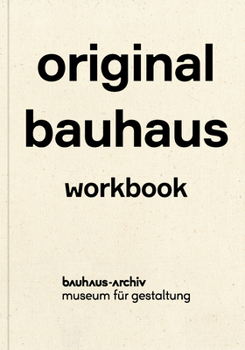
Original Bauhaus Workbook
No Customer Reviews

Take a class at The Bauhaus school with this interactive introduction that lets you experience what it was like to study at the influential school and try out some of the original exercises taught there. Between 1919 and 1933 the Bauhaus thrived as a school of ideas that encouraged students to experiment with arts, crafts, design, and architecture. One hundred years later, its educational methods are still relevant. This book presents its teachings, the people behind it, and their works. It traces the history of the school as it evolved from a Utopian craft guild to a more utilitarian design school--all amid the extraordinary social and political upheaval in 1920s and '30s Germany. It profiles some of the major instructors, including Joseph Albers, Wassily Kandinsky, Johannes Itten, and L szl Moholy-Nagy. It also offers a series of fifty-four exercises similar to ones these instructors had given their students. Some of these exercises pertain to color theory--one of the school's most enduring legacies--others show how to build collages or assemblages out of found materials, while others offer valuable lessons on perspective. Readers can take Kandinsky's famous color questionnaire, which matches three elemental shapes with the three primary colors, and learn how to draw a line or a grid the way Paul Klee would teach. These teachings not only illustrate the methods and philosophy of the Bauhaus school, but they also provide budding artists a foundation for developing their own practice, whether it be in drawing, architecture, design, or typography. Fun and educational, this book brings the collective wisdom of the Bauhaus philosophy into your home, studio, or classroom.
Format:Hardcover
Language:English
ISBN:3791359029
ISBN13:9783791359021
Release Date:November 2019
Publisher:Prestel Publishing
Length:160 Pages
Weight:1.40 lbs.
Dimensions:0.5" x 8.3" x 12.1"
Customer Reviews
0 rating
Copyright © 2026 Thriftbooks.com
Terms of Use | Privacy Policy | Do Not Sell/Share My Personal Information | Cookie Policy | Cookie Preferences | Accessibility Statement
ThriftBooks ® and the ThriftBooks ® logo are registered trademarks of Thrift Books Global, LLC
ThriftBooks ® and the ThriftBooks ® logo are registered trademarks of Thrift Books Global, LLC
