


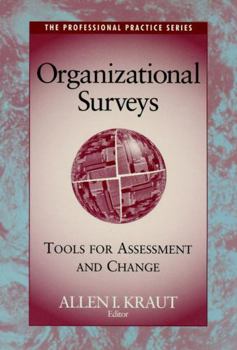
Organizational Surveys: Tools for Assessment and Change


Select Format
Select Condition 
Book Overview
With escalating demands upon research and assessment growing morevaried, surveys are now used to assess and drive organizationalchange by examining company performance, customer and employeesatisfaction, empowerment, and key aspects of corporateculture. With Organizational Surveys, you'll learn how to: * Drive change with surveys * Use 360* feedback * Set expectations of results * Deal with ethical concerns * Facilitate feedback, action-planning, and follow-through . . .and much more No other book approaches this collection's range and specificity, or its emphasis on actual practice in organizations. It's yourindispensible toolbox for assessment and change
Format:Paperback
Language:English
ISBN:0787902349
ISBN13:9780787902346
Release Date:July 1996
Publisher:Pfeiffer
Length:448 Pages
Weight:1.59 lbs.
Dimensions:1.2" x 6.1" x 9.1"
Customer Reviews
2 ratings
Comprehensive - but needs an update to accommodate internet surveys and other methodological develop
Published by Thriftbooks.com User , 20 years ago
I purchased this 418pp volume in 1998 and recently re-read this book to reacquaint myself with the rich material. What Kraut has done as an editor is to select 35 pertinent papers that discuss Organizational Surveys under three main heading: 1) Purposes and uses. 2) The Survey process. 3) Special applications - such as linking survey results to "hard" figures such as productivity and performance. The book is packed with sage advice, both academic and practical. For example it counsels researchers to work closely with insiders in order to get the most useful surveys, and it spends many pages discussing the questions of implementing the recommendations and the whole issue of raising employee expectations by even conducting surveys. But what a lot has occurred in the 10 years since this book was edited. I find on re-reading that several cutting-edge ideas (linking internal results to customer satisfaction measures) are fairly standard now; and of-course the advent of web-based online surveys has had a major effect upon the practicability and style of conducting employee research. Online surveys, with their wonderful capacity to capture open-enders, really enable researchers to glue their quant findings much closer to qualitative styles of research including focus groups (given scant coverage here) and ethnography: the act of observing how the organisation does things. In essence, I don't feel the collection of papers deals quite adequately with the central question: what is it that makes organizational research and surveys different from other kinds of research. One key difference is the question of culture, and the way sub-units within an organisation may act as distinct and cohesive "tribes" capable of affirming, or subverting the overall objectives of the organisation by applying their sense of values, sense of fairness and sense of direction to their day-to-day involvement. Fascinating stuff - but this volume only discusses such issues in a generic manner. In short, the publishers might be prompted to consider a new updated edition. This book was state of the art 10 years ago, but its relevance is diminishing. I still give it four stars (just) because of the quality of the writing and the value of its insights - but the book is no longer solid gold. There's rust appearing on the bodywork, and readers will need to find other volumes to accompany this one. That's not a bad approach because the subject-matter has evolved quickly.
Was good to the last chapter...then was a downer.
Published by Thriftbooks.com User , 27 years ago
Book covers a wide variety of survey topics very well. I underlined a great many thoughts. One thought that occured to me was that I was on my way to doing Organizational Surveys. But at the end was warned "I would be a 'bounder' if I read a few books and started practicing." It seems this book's final conclusion is that you need to join the Union to do surverys, ie. be a phd or working under one. The book was still a great value.
Copyright © 2026 Thriftbooks.com Terms of Use
| Privacy Policy | Do Not
Sell/Share My Personal Information | Cookie Policy | Cookie Preferences | Accessibility Statement
ThriftBooks® and the ThriftBooks® logo are registered trademarks of Thrift Books Global, LLC
ThriftBooks® and the ThriftBooks® logo are registered trademarks of Thrift Books Global, LLC
