
Skip to content
Scan a barcode
Scan
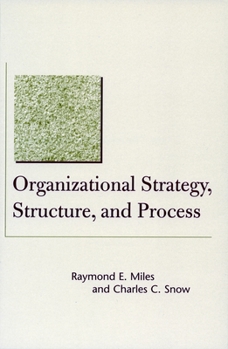
Paperback Organizational Strategy, Structure, and Process Book

ISBN: 0804748403

ISBN13: 9780804748407

Organizational Strategy, Structure, and Process

Select Format

Select Condition ThriftBooks Help Icon

Recommended

Format: Paperback

Condition: New

$39.86
Save $5.14!
List Price $45.00
50 Available
Ships within 2-3 days

Book Overview

"Books and articles come and go, endlessly. But a few do stick, and this book is such a one. Organizational Strategy, Structure, and Process broke fresh ground in the understanding of strategy at a time when thinking about strategy was still in its early days, and it has not been displaced since."

--David J. Hickson, Emeritus Professor of International Management & Organization, University of Bradford School of Management

Originally published in 1978, Organizational Strategy, Structure, and Process became an instant classic, as it bridged the formerly separate fields of strategic management and organizational behavior. In this Stanford Business Classics reissue, noted strategy scholar Donald Hambrick provides a new introduction that describes the book's contribution to the field of organization studies. Miles and Snow also contribute new introductory material to update the book's central concepts and themes.

Organizational Strategy, Structure, and Process focuses on how organizations adapt to their environments. The book introduced a theoretical framework composed of a dynamic adaptive cycle and an empirically based strategy typology showing four different types of adaptation. This framework helped to define subsequent research by other scholars on important topics such as configurational analysis, organizational fit, strategic human resource management, and multi-firm network organizations.

Customer Reviews

2 ratings

Applicable examples

The book includes excellent research examples that can be rapidly compare with the current manufacturing industry events. Although the theory was initiated a long time ago, the adjustment and expansion to this incipient century is applicable.

Framework for strategy classification

Raymond E. Miles is Professor Emeritus and former Dean of the Haas School of Business, University of California, Berkeley. Charles C. Snow is Professor of Business Administration at Penn State University. The original version of this book was published in 1978, whereby this review involves the Stanford Business Classics 2003-version which includes an additional foreword and a new introduction. The book is split in 3 parts, with the first part consisting of 10 chapters, the second part of 3 chapters, while the final part provides an overview of the literature. The authors start firmly in the first introductory chapter: "An organization is both an articulated purpose and an established mechanism for achieving it." Miles and Snow believe that the complexity of the adjustment process can be penetrated by searching for patterns in the behavior of organizations. The cornerstones of the framework consist of 3 pivotal ideas introduced and developed by a number of other authors: (1) Organizations act to create their environment. (2) Management's strategic choices shape the organization's structure and process. (3) Structure and process constrain strategy. The book has five major objectives. In the second chapter the authors introduce the first objective, which is to develop an understanding of the process by which organizations continually adjust to their environments. The second objective is to provide an explanation for the alternative forms of adaptive behavior which exist in the industries studied by the authors and which are probably present in most other industries. In the second chapter a typology of these forms of organization, termed `strategic types' are presented and further elaborated in chapters 3 through to 6. In chapter 7 the authors pursue the third objective, the development of an approach for diagnosing the relationship between organizations and their environments that utilizes the adaptive cycle and the four strategic types. The authors' fourth objective is to create a heightened awareness of the degree to which successful organizational diagnosis and change hinges on managers' theories about how people can and should be managed. In chapter 9 the authors address the fifth and final objective, which is to create a conceptual foundation for the examination of emerging organizational forms. Chapter 10 summarizes and concludes on the major points offered in the first 9 chapters. It also speculates about future organizational forms and management theories. "Our theoretical framework is in no sense complete, as modifications and extensions will undoubtedly occur. ... We did not reach the summit, but we have a good idea where the best route lies." The final 4 chapters supply more detailed descriptions of the authors' research and interpretation of the literature. Final chapter 14 is a nontechnical overview of the literature related to organization-environment relations. Yes, I do like this book. In retrospect one can say that this book has
Copyright © 2026 Thriftbooks.com Terms of Use | Privacy Policy | Do Not Sell/Share My Personal Information | Cookie Policy | Cookie Preferences | Accessibility Statement
ThriftBooks® and the ThriftBooks® logo are registered trademarks of Thrift Books Global, LLC

GoDaddy Verified and Secured