


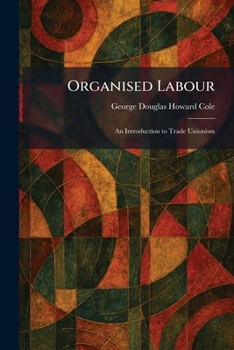
Organised Labour: An Introduction to Trade Unionism

"Organised Labour: An Introduction to Trade Unionism" is a foundational study of the labor movement during a pivotal era of social and economic transformation. Written by the influential social theorist and economist G. D. H. Cole, the work provides a comprehensive overview of the structure, functions, and aspirations of trade unions in the early 20th century.
Cole examines the evolution of organized labor, detailing the mechanisms of collective bargaining and the strategic roles unions play within industrial society. The book delves into the internal organization of labor groups, the relationship between workers and management, and the broader political implications of the movement. This volume serves as an essential resource for understanding the historical development of labor rights and the philosophical foundations of industrial democracy.
Cole's analysis is not merely a record of past events but a deep exploration of the principles that continue to shape industrial relations and economic policy. It remains a vital text for students of history, political science, and social theory, offering profound insights into the collective efforts of the working class to secure better conditions and a greater voice in their economic lives.
This work has been selected by scholars as being culturally important, and is part of the knowledge base of civilization as we know it. This work was reproduced from the original artifact, and remains as true to the original work as possible. Therefore, you may see the original copyright references, library stamps (as most of these works have been housed in our most important libraries around the world), and other notations in the work.
This work is in the public domain in the United States of America, and possibly other nations. Within the United States, you may freely copy and distribute this work, as no entity (individual or corporate) has a copyright on the body of the work.
As a reproduction of a historical artifact, this work may contain missing or blurred pages, poor pictures, errant marks, etc. Scholars believe, and we concur, that this work is important enough to be preserved, reproduced, and made generally available to the public. We appreciate your support of the preservation process, and thank you for being an important part of keeping this knowledge alive and relevant.
Related Subjects
Business Business & Investing Economics Political Science Politics & Social SciencesCustomer Reviews
ThriftBooks ® and the ThriftBooks ® logo are registered trademarks of Thrift Books Global, LLC
