


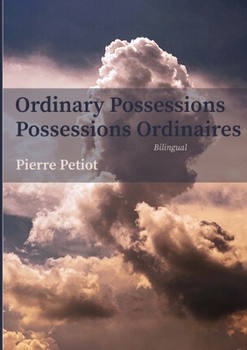
Ordinary Possessions - Possessions Ordinaires: Technology and Mental Simulations
No Customer Reviews

Since the end of Upper Paleolithic, the things by which we live, of which we believe ourselves masters, whether technical objects (furniture, tools, machines) or intellectual objects (images, ideas, methods), transform our minds in return and creep into our behaviors, our actions, and even into our sex lives. The ghosts of our things, which permanently haunt us, almost always unconsciously, have shaped our societies and our visions. In modern societies, the disappearing of work as a conscious material transformation of the world and the generalized diffusion of managerial slang, eviscerate language, making it unsuitable for any poetry. But, when poetry disappears, the desire and pleasure of living disappear with it, leading to this generalized anesthesia so characteristic of the time. Recovering poetry, and the taste for life with it, first of all requires to accept our native symbiosis with our things, but a symbiosis henceforth, thought, conscious, and lived. It also means to (re-)build free forms of collective work. The ecological crisis can help us ... ------------------------------------------------------------------------------------------------------------ Depuis la fin du Pal?olithique sup?rieur, les choses par quoi nous vivons, dont nous nous croyons ma?tres, objets techniques (meubles, outils, machines) ou intellectuels (images, id?es, m?thodes), transforment en retour nos esprits, s'insinuent dans nos conduites, nos gestes, et jusque dans nos sexualit?s. Les spectres de nos choses qui nous hantent, pour l'essentiel ? notre insu, ont fa?onn? nos soci?t?s et nos visions. Dans les soci?t?s modernes, la disparition du travail comme transformation mat?rielle consciente du monde et la diffusion g?n?ralis?e de la langue de bois manag?riale ?visc?rent le langage, le rendant impropre ? toute po?sie. Mais quand la po?sie dispara?t, le d?sir et le plaisir de vivre, disparaissent avec elle, conduisant ? cette anesth?sie g?n?rale caract?ristique de l'?poque. Recouvrer la po?sie, et le go?t de vivre avec, c'est d'abord accepter notre symbiose native avec nos choses, mais une symbiose d?sormais, pens?e, consciente, v?cue. C'est (re-)construire des formes de travail collectif libres. La crise ?cologique peut nous aider...
Format:Paperback
Language:English
ISBN:1794842977
ISBN13:9781794842977
Release Date:November 2021
Publisher:Lulu.com
Length:186 Pages
Weight:0.50 lbs.
Dimensions:0.4" x 5.8" x 8.3"
Customer Reviews
0 rating
Copyright © 2026 Thriftbooks.com Terms of Use
| Privacy Policy | Do Not
Sell/Share My Personal Information | Cookie Policy | Cookie Preferences | Accessibility Statement
ThriftBooks® and the ThriftBooks® logo are registered trademarks of Thrift Books Global, LLC
ThriftBooks® and the ThriftBooks® logo are registered trademarks of Thrift Books Global, LLC
