


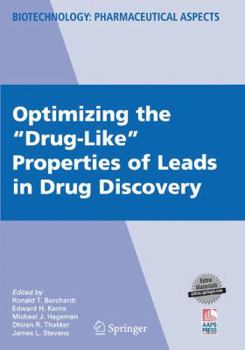
Optimizing the Drug-Like Properties of Leads in Drug Discovery
No Customer Reviews

Drug discovery and development is a very complex, costly, and ti- consuming process. Because of the uncertainties associated with predicting the pharmacological effects and the toxicity characteristics of new chemical entities in man, their clinical development is quite prone to failure. In recent years, phar- ceutical companies have come under increasing pressure to introduce new blockbuster drugs into the marketplace more rapidly. Companies have responded to these pressures by introducing new technologies and new strategies to expedite drug discovery and development. Drug discovery and development have traditionally been divided into three separate processes (i. e., discovery research, preclinical development, and clinical development) that ideally should be integrated both organizationally and functionally. Instead, separate and distinct discovery research, preclinical development, and clinical development divisions were created within many companies during the 1980s and 1990s, Because of their isolation, scientists in the discovery research divisions often were advancing drug candidates into preclinical development that had marginal drug-like properties. For the purpose of this presentation, "drug-like" properties refer to the molecule's physicochemical, absorption-distribution-metabolism-excretion (ADME), and toxicological properties. Lacking optimal drug-like properties often caused these drug candidates to fail in preclinical or clinical development.
Format:Paperback
Language:English
ISBN:1493950479
ISBN13:9781493950478
Release Date:October 2016
Publisher:Springer
Length:512 Pages
Weight:1.99 lbs.
Dimensions:1.1" x 7.0" x 10.0"
Customer Reviews
0 rating
Copyright © 2026 Thriftbooks.com Terms of Use
| Privacy Policy | Do Not
Sell/Share My Personal Information | Cookie Policy | Cookie Preferences | Accessibility Statement
ThriftBooks® and the ThriftBooks® logo are registered trademarks of Thrift Books Global, LLC
ThriftBooks® and the ThriftBooks® logo are registered trademarks of Thrift Books Global, LLC
