



Select Format
Select Condition 
Book Overview
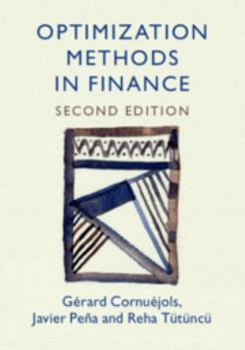
Optimization methods play a central role in financial modeling. This textbook is devoted to explaining how state-of-the-art optimization theory, algorithms, and software can be used to efficiently solve problems in computational finance. It discusses some classical mean-variance portfolio optimization models as well as more modern developments such as models for optimal trade execution and dynamic portfolio allocation with transaction costs and taxes. Chapters discussing the theory and efficient solution methods for the main classes of optimization problems alternate with chapters discussing their use in the modeling and solution of central problems in mathematical finance. This book will be interesting and useful for students, academics, and practitioners with a background in mathematics, operations research, or financial engineering. The second edition includes new examples and exercises as well as a more detailed discussion of mean-variance optimization, multi-period models, and additional material to highlight the relevance to finance.
Format:Hardcover
Language:English
ISBN:1107056748
ISBN13:9781107056749
Release Date:September 2018
Publisher:Cambridge University Press
Length:348 Pages
Weight:1.65 lbs.
Dimensions:0.8" x 7.0" x 10.0"
Customer Reviews
2 ratings
Wonderful book with lots of financial applications
Published by Thriftbooks.com User , 19 years ago
This book is very well-written with some theories and tons of financial applications. I hadn't thought that a GARCH model for estimating stochastic volatility can be seen as a nonlinear programming application. It touches some relatively modern/advanced topics such as robust optimization and cone optimization. It's just a wonderful optimization book for financial engineers and people in the financial industry.
Modern view, balanced coverage of optimization methods for quantitative finance
Published by Thriftbooks.com User , 19 years ago
This is a very up-to-date book featuring complete, balanced coverage of optimization methods used in quantitative finance. It should be a great resource for practitioners in financial engineering or portfolio management who need to know what methods to apply to different problems, and how to evaluate competing vendor claims, without going too deeply into the algorithmic details of each optimization method. The book has 20 chapters that alternate between an overview of a class of optimization methods, then a set of examples applying those methods to problems in quantitative finance: * Linear programming, with applications to asset/liability cash flow matching and arbitrage detection * Nonlinear programming, with applications to volatility estimation * Quadratic programming, with good coverage of mean-variance portfolio optimization * Conic optimization, with several applications: index tracking, approximating covariance matrices, recovering risk-neutral probabilities from option prices * Integer programming, with applications to index fund construction and combinatorial auctions * Dynamic programming, with applications to pricing American options * Stochastic programming, with applications that minimize Conditional Value at Risk, and manage assets and liabilities over multiple periods * Robust optimization, with models to deal with estimation risk in portfolio optimization It's difficult to find another book with this breadth of coverage of optimization methods, especially with a focus on quantitative finance. It's also difficult to find another book that treats modern methods of conic optimization and robust optimization, which have growing importance in finance. Granted, the treatment of the different applications is not meant to be comprehensive -- it's really just enough to give the reader an idea of how each problem can be approached, with appropriate references to the academic literature to learn more. There are some references to available software for the different methods, but this is a brief and partial snapshot; commercial software for the newer methods is getting better all the time. Appendices provide brief, helpful introductions to four key technical topics in optimization: Convexity, cones, probability, and the revised Simplex method. An understanding of convexity and cones is essential to an appreciation of modern methods of conic and robust optimization, and certainly anyone working in this field needs an understanding of probability and the Simplex method for linear programming. I believe this book fills a need that has existed for some time: For the quantitative finance practitioner with way too much technical literature to deal with, it provides a comprehensive, modern introduction to optimization methods that makes efficient use of the reader's time. It's well worth the price for someone working in this field.
Copyright © 2026 Thriftbooks.com
Terms of Use | Privacy Policy | Do Not Sell/Share My Personal Information | Cookie Policy | Cookie Preferences | Accessibility Statement
ThriftBooks ® and the ThriftBooks ® logo are registered trademarks of Thrift Books Global, LLC
ThriftBooks ® and the ThriftBooks ® logo are registered trademarks of Thrift Books Global, LLC
