


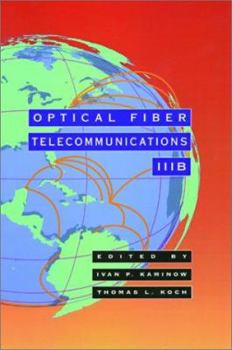
Optical Fiber Telecommunications IIIB (Volume 3B) (Optics and Photonics, Volume 3B)

Updated to include the latest information on light wave technology, Optical Fiber Telecommunication III, Volumes A & B are invaluable for scientists, students, and engineers in the modern... This description may be from another edition of this product.
Format:Hardcover
Language:English
ISBN:0123951712
ISBN13:9780123951717
Release Date:April 1997
Publisher:Academic Press
Length:515 Pages
Weight:1.90 lbs.
Dimensions:9.5" x 1.3" x 6.5"
Customer Reviews
3 ratings
A great two-volume set
Published by Thriftbooks.com User , 25 years ago
This is the second book in a two-volume set. Volume IIIA (608 pages) deals primarily with system-related issues. The second volume, IIIB (515 pages) delves into greater detail regarding the design and performance of critical components used in optical fiber telecommunications. Like volume IIIA, volume IIIB consists of chapters written by different authors. Although many of the chapter authors come from Lucent and/or Bell Labs, they do a good job of keeping the book at an academic level that is largely devoid of excess or offensive commercialism. This is a first-rate book that needs to be read and understood by anyone seriously engaged in engineering activities related to optical fiber telecommunications. Each chapter is written in what is an essentially self-contained manner (though many chapters make reference from time to time to other chapters in either of the two volumes - a welcome thing as it brings continuity to the two-volume set). After a nice overview by Kaminow, volume IIIB dives right into what is arguably the single most important optical component to be developed for telecommunications in the 90's: the erbium-doped fiber amplifier. As with most chapters, chapter 2 does not overwhelm the reader with long mathematical derivations. Instead, it places at the engineer's disposal the relevant mathematical equations necessary for important analysis, as well as a wealth of references at the end of the chapter that facilitate further reading and the most quantitative analysis. This chapter covers all the important features of amplifier design, from gain to saturation, noise figure, coupling loss, polarization effects, pumping schemes, components, and various ways in which the amplifier may be used (in-line amplifier, power amplifier, etc.).Chapter three covers transmitter and receiver design for amplified lightwave systems. The material in this chapter is high level. Topics include things like extinction ratio, rise/fall time, chirp, mode partitioning, and polarization mode dispersion. The emphasis is on how specific attributes of the transmitter and receiver interact with other components in the transmission system to affect overall system performance. Thus, the chapter not only discusses what laser chirp is, what causes it, and how to reduce it, it also delves into the system implications of chirp and describes why it is bad, and how to determine how much you can tolerate. Chapters four, five, and six are something of a trilogy. Chapter four introduces the idea of laser sources in general for amplified and WDM lightwave systems. Chapter 5 continues the subject by describing advances in semiconductor laser growth and fabrication technology. Chapter 6 goes into more specific detail regarding vertical-cavity surface-emitting lasers. Of these three chapters, chapter four is the most generic, and (at least for me) by far the easiest to follow. Chapter four covers subjects like direct mod
Useful and timely
Published by Thriftbooks.com User , 26 years ago
Chapter 12 is worth the price alone: The authors have done a remarkable job of getting to the heart of solitions.
A comprehensive review
Published by Thriftbooks.com User , 26 years ago
Optical Fiber Telecommunications III is designed for anyone engaged in engineering work related to the fiber-optics telecommunications industry. There seems to be little doubt about the revolutionary path leading to full deployment of fiber in the telecommunications backbone network, or the trends moving fiber closer to and closer to end users. Yet, while this continual deepening of fiber into the national network progresses steadily, a new revolution has overtaken photonics in the backbone: dense wavelength-division multiplexing, or DWDM. DWDM, perhaps more than any other technology, is the reason that the third edition of this seminal work is needed today. It's not too surprising, then, that most of the third edition is directly or indirectly related to design concerns related to DWDM.This text is best described as an engineer's desk reference. The scope is large, necessitating breaking the book into two volumes. Volume III A deals mostly with system issues and concerns, delving into more esoteric component issues primarily to illustrate the wider network implications. Volume III B deals more with specific component design issues, such as sources, detectors, and erbium-doped fiber amplifiers (EDFAs). As a desk reference, there are few derivations of equations from first principles. Perhaps the closest derivation is that of the nonlinear Schrodinger equation in chapter 12 on soliton transmission. Even here, however, the derivation is sketchy at best. For the most part the book simply places the equations at the reader's disposal. I found most of the equations are explained well, and most of the chapter authors included numeric examples, charts, and graphs. This helps immensely in understanding the implications of the many equations presented throughout the text. For those interested in derivations, each chapter comes with extensive endnotes so that anyone interested in reviewing the original work can easily do so. One problem with the text revolves around definitions of mathematical variables and constants. Though they are all defined as introduced to the reader, there is no glossary of these terms. I constantly found myself writing in the books margins little notes like "alpha is the total loss coefficient, first used in equation x on page y." Since different authors write each chapter in the book, it may not be practical to have a glossary of terms for the entire volume - usage will probably overlap. Still, it would be nice had the editors suggested that each chapter have a glossary of mathematical variables. It would make the book far more practical and useful as a desk reference. On a more positive note, however, the book does contain a detailed and useful index. Even without derivations, the book contains a plethora of equations and charts to satisfy the needs of most quantitatively oriented engineers. It's a good introductory book for those with a modest background in optical t
Copyright © 2026 Thriftbooks.com Terms of Use
| Privacy Policy | Do Not
Sell/Share My Personal Information | Cookie Policy | Cookie Preferences | Accessibility Statement
ThriftBooks® and the ThriftBooks® logo are registered trademarks of Thrift Books Global, LLC
ThriftBooks® and the ThriftBooks® logo are registered trademarks of Thrift Books Global, LLC
