


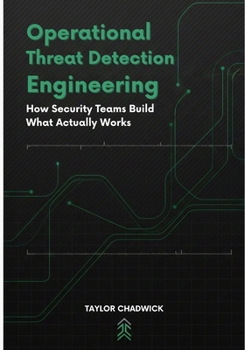
Operational Threat Detection Engineering: How Security Teams Build What Actually works

Most security teams don't fail because they lack tools. They fail because their detections don't survive contact with reality.
Alerts fire constantly, analysts drown in noise, and genuinely dangerous activity slips through because the rules looked good on paper but collapsed in production. If you've ever shipped a detection that "worked" in testing and then quietly got disabled weeks later, this book is for you.
Operational Threat Detection Engineering: How Security Teams Build What Actually Works is a practical, experience-driven guide to building detections that hold up under real operational pressure. This book focuses on how modern security teams design, test, deploy, and maintain detection logic that reduces noise, scales with the environment, and produces incidents worth responding to. The emphasis is not theory or vendor marketing, but the mechanics of making detections durable in live systems.
Rather than treating detections as static rules, the book shows how to think in terms of behaviors, sequences, and attacker narratives. It covers how teams move from single-event alerts to correlated signals, how detections evolve over time, and how engineering discipline changes the outcome of a SOC. Every concept is framed around what defenders actually see in logs, endpoints, identity systems, and networks.
By the end of this book, readers will be able to:
Design detection logic that aligns with attacker behavior, not isolated indicators
Build and reason about sequence-based detections and stateful logic
Reduce false positives without blinding coverage
Validate detections using real telemetry and adversary tradecraft
Operate detections as long-lived systems, not one-off rules
Collaborate effectively between detection engineers, SOC analysts, and incident responders
This book is written for security engineers, detection engineers, blue team leads, and SOC practitioners who want fewer alerts and more confirmed incidents. It speaks plainly, prioritizes what works, and avoids unnecessary complexity.
If you're ready to stop writing detections that look impressive and start building ones that survive production, Order this book and put your detection program on solid operational ground.
Customer Reviews
ThriftBooks® and the ThriftBooks® logo are registered trademarks of Thrift Books Global, LLC
