


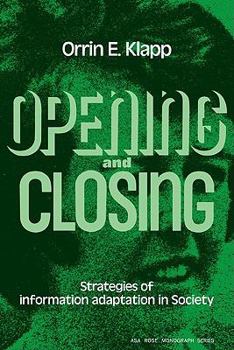
Opening and Closing
No Customer Reviews

In this original application of information theory to social analysis, Orrin Klapp examines how and why societies are producing more stress than they ever can handle. He argues that the reduction of 'social noise', the chaos from which we try to construct meaning is a major goal of individuals and groups alike. Individuals, groups, even entire societies normally cycle rhythmically between two basic modes of adaptation to the constant communication flow: opening, or scanning for desired information; and closing, or defending against noise. For example, in a society functioning in the opening mode, movements like ecumenicism and expansionism achieve momentum. Extreme reactions in either mode lead to an opposite swing, according to Professor Klapp's model. His wide-ranging conceptual scheme incorporates hypotheses about the variety and redundancy of information, as well as about human channel capacities and the need for homeostatis. His research reveals intriguing relationships among such phenomena as the concern about industrial population and the search for ethnic roots.
Format:Paperback
Language:English
ISBN:0521293111
ISBN13:9780521293112
Release Date:September 1978
Publisher:Cambridge University Press
Length:240 Pages
Weight:0.76 lbs.
Dimensions:0.6" x 6.0" x 9.0"
Customer Reviews
0 rating
Copyright © 2026 Thriftbooks.com Terms of Use
| Privacy Policy | Do Not
Sell/Share My Personal Information | Cookie Policy | Cookie Preferences | Accessibility Statement
ThriftBooks® and the ThriftBooks® logo are registered trademarks of Thrift Books Global, LLC
ThriftBooks® and the ThriftBooks® logo are registered trademarks of Thrift Books Global, LLC
