


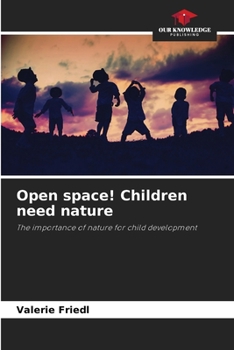
Open space! Children need nature
No Customer Reviews

Due to social developments, it seems as though the value of closeness to nature and experiences of nature are becoming less important to people. At the same time, in recent years, more and more scientists have been studying the positive effects of natural environments and attribute great potential to them, especially with regard to child development. This paper deals with the question of the extent to which nature still represents a learning and living space for children.The aim is to determine whether and how nature can be used as a resource in social education practice and what goals can be achieved as a result. The concept of holism, as well as findings from neuroscience, provide relevant insights into the questions to be answered.
Format:Paperback
Language:English
ISBN:620073870X
ISBN13:9786200738707
Release Date:July 2025
Publisher:Our Knowledge Publishing
Length:52 Pages
Weight:0.18 lbs.
Dimensions:0.1" x 6.0" x 9.0"
Customer Reviews
0 rating
Copyright © 2026 Thriftbooks.com
Terms of Use | Privacy Policy | Do Not Sell/Share My Personal Information | Cookie Policy | Cookie Preferences | Accessibility Statement
ThriftBooks ® and the ThriftBooks ® logo are registered trademarks of Thrift Books Global, LLC
ThriftBooks ® and the ThriftBooks ® logo are registered trademarks of Thrift Books Global, LLC
