


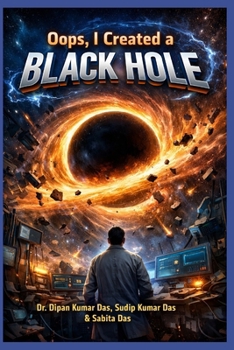
Oops, I Created a Black Hole

Chapter 1: The Experiment That Wasn't Supposed to Matter
Dr. Arin Dev considered the experiment trivial. A tabletop simulation of gravitational compression, nothing more than a curiosity project squeezed between serious research. The equations were elegant, the setup minimal, and the expectations nearly nonexistent. That was precisely why he liked it. No pressure. No consequences. Just physics behaving politely. Except, physics rarely stayed polite for long.
Chapter 2: A Flicker in the VacuumThe first anomaly appeared as a flicker-an almost shy distortion in the containment field. Arin leaned closer, dismissing it as interference. But the sensors disagreed. Energy density spiked where nothing should exist. Space itself seemed to hesitate, as though unsure of its own structure. That hesitation was the first crack in reality.
Chapter 3: The Birth of the ImpossibleIt began as a point. Infinitesimally small, yet impossibly dense. Arin stared at the data, heart pounding against reason. A singularity. Not theoretical. Not cosmic. Right there, humming softly in a lab built for simulations.He whispered the words no physicist expects to say out loud: "I think I just made a black hole."
Chapter 4: Containment and DenialProtocols activated automatically, sealing the chamber. Alarms remained silent, as though the system itself didn't recognize the threat. Arin tried to rationalize. It must be a transient artifact. A glitch. A computational ghost leaking into reality. But the gravitational readings continued to climb. Denial, like gravity, only holds for so long.
Chapter 5: When Space Starts BendingObjects near the chamber began to shift subtly. A pen rolled without being touched. Light curved at strange angles. The air felt heavier, thicker, as if space itself had weight. Arin realized the terrifying truth: the black hole was not stable.
It was growing.
He returned to his calculations, searching for error. Instead, he found something worse. The equations predicted this outcome. Not by mistake, but by inevitability. A hidden solution buried deep within the mathematics, overlooked because no one expected it to be real. He hadn't broken physics. He had followed it too well.
Chapter 7: The First LossThe containment probe vanished first. No explosion, no sound. Just gone. Consumed. The data stream cut off mid-signal, leaving only silence. Arin felt a chill that had nothing to do with temperature. This wasn't just an experiment anymore. It was a threshold-one that had already been crossed.
Chapter 8: Time Begins to SlipClocks in the lab started to desynchronize. Seconds stretched, then snapped back. Arin experienced moments twice, then not at all. Time, once a steady companion, had become unreliable. The black hole wasn't just devouring matter.
It was rewriting the rules of existence.
Arin faced the inevitable question: shut it down or study it. The scientist in him burned with curiosity. The human in him recoiled with fear. Knowledge demanded risk, but this risk extended beyond himself. For the first time, he understood the true cost of discovery.
Chapter 10: A Decision at the Edge of RealityHe devised a plan-reverse the energy input, destabilize the singularity, collapse it before it grew uncontrollably. The calculations were precise, but precision meant nothing in the presence of the unknown. He hesitated only once. Then he began.
Chapter 11: What RemainsThe chamber returned to stillness. The readings dropped to zero. Space straightened itself as if embarrassed by its earlier behavior. The black hole was gone. Or so it seemed. On Arin's desk, a faint distortion lingered, barely visible, like a memory refusing to fade. He stared at it, understanding something he hadn't before: Some discoveries don't end. They wait.
Customer Reviews
ThriftBooks ® and the ThriftBooks ® logo are registered trademarks of Thrift Books Global, LLC
