


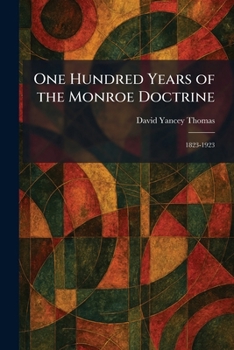
One Hundred Years of the Monroe Doctrine: 1823-1923

Select Format
Select Condition 
Book Overview
"One Hundred Years of the Monroe Doctrine, 1823-1923" is a comprehensive historical and analytical study of one of the most significant pillars of United States foreign policy. Written by David Y. Thomas, this work examines the evolution of the Monroe Doctrine from its inception under President James Monroe to its status during the early 20th century. The book traces how a policy originally intended to prevent European colonization in the Americas expanded and shifted in its application over a century of geopolitical change.
The text explores key diplomatic developments, including the doctrine's role in Pan-American relations, its influence on territorial disputes, and its impact on the United States' emergence as a global power. Thomas provides a detailed look at various interpretations of the doctrine by successive administrations, analyzing its effects on both North and South American sovereignty. This scholarly review serves as an essential resource for understanding the foundations of American diplomacy and the complex relationship between the United States and the Western Hemisphere. Through a rigorous examination of historical records and international events, "One Hundred Years of the Monroe Doctrine, 1823-1923" offers valuable insights into the long-standing principles that have shaped modern international relations.
This work has been selected by scholars as being culturally important, and is part of the knowledge base of civilization as we know it. This work was reproduced from the original artifact, and remains as true to the original work as possible. Therefore, you may see the original copyright references, library stamps (as most of these works have been housed in our most important libraries around the world), and other notations in the work.
This work is in the public domain in the United States of America, and possibly other nations. Within the United States, you may freely copy and distribute this work, as no entity (individual or corporate) has a copyright on the body of the work.
As a reproduction of a historical artifact, this work may contain missing or blurred pages, poor pictures, errant marks, etc. Scholars believe, and we concur, that this work is important enough to be preserved, reproduced, and made generally available to the public. We appreciate your support of the preservation process, and thank you for being an important part of keeping this knowledge alive and relevant.
Customer Reviews
ThriftBooks ® and the ThriftBooks ® logo are registered trademarks of Thrift Books Global, LLC
