


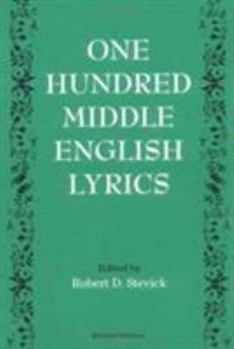
One Hundred Middle English Lyrics


Select Format
Select Condition 
Book Overview
Stevick's classic work remains the only text of its kind aimed at fostering
the linguistic competence necessary to understand its poems in Middle
English. The wide range of lyric poems in the book are normalized to a
Chaucerian dialect. The introduction has been revised to take into account
the scholarship and criticism published since the first edition appeared
in 1964. It gives the background for the poetry, explains how and why
the texts are normalized, and reviews significant critical scholarly studies
of the works. Included is a section on morphology and grammar that introduces
students to the language of the lyrics, and a section on the evolving
meter of Middle English.
"A fine piece of work. . . . Learned, wide-ranging, and judicious."
-- John B. Friedman, author of The Monstrous Races in Medieval
Art and Thought
"An impressive collection. Stevick's decision to normalize the texts
makes it highly accessible."
-- Ralph Hanna III, University of California, Riverside
the linguistic competence necessary to understand its poems in Middle
English. The wide range of lyric poems in the book are normalized to a
Chaucerian dialect. The introduction has been revised to take into account
the scholarship and criticism published since the first edition appeared
in 1964. It gives the background for the poetry, explains how and why
the texts are normalized, and reviews significant critical scholarly studies
of the works. Included is a section on morphology and grammar that introduces
students to the language of the lyrics, and a section on the evolving
meter of Middle English.
"A fine piece of work. . . . Learned, wide-ranging, and judicious."
-- John B. Friedman, author of The Monstrous Races in Medieval
Art and Thought
"An impressive collection. Stevick's decision to normalize the texts
makes it highly accessible."
-- Ralph Hanna III, University of California, Riverside
Format:Paperback
Language:English
ISBN:0252063791
ISBN13:9780252063794
Release Date:May 1994
Publisher:University of Illinois Press
Length:248 Pages
Weight:1.35 lbs.
Dimensions:0.7" x 6.0" x 9.0"
Customer Reviews
1 rating
One Hundred Middle English Lyrics
Published by Thriftbooks.com User , 17 years ago
The volume 'One Hundred Middle English Lyrics' edited by Robert D. Stevick has astounding content, an insightful introduction, but sadly lacks any explanation of individual poems. Stevick arranges his poems in approximate chronological order so that the keen reader can trace thematic and stylistic changes. Thankfully Stevick does not translate the poems into modern English or keep each poem in its original dialect (of which thousands existed), a method that would require every "potential reader of Middle English lyrics to serve an apprenticeship to the trade of philology" but instead presents the texts in the single Middle English written dialect of Chaucer and his contemporaries. His reasoning in using this dialect is as follows, "historically, it stands near the line of development of Modern Standard English and probably is the dialect of more of the Middle English verse now commonly read than any other" (pg xi). In doing away with local dialects Stevick might be obscuring some meaning but not nearly as much as a translation into modern English would. That said, these fascinating poems are now more approachable to the novice Middle English reader (or even first timer willing to trudge through thenk (think), dere (injure), gril (harsh), leeste wenest (least expect), etc). Since this volume is calculated to "suit both the initiated and less skilled reader" of Middle English Stevick provides an extensive glosses on each page as well as a glossary of more common words. Also, when the poems use lines of Latin all of these phrases are translated. For the reader who really wants to learn Middle English, Stevick provides pages on the linguistic traits found in this edition and some charts of personal pronouns, nouns, adjectives, and phonetic reconstructions of consonant sounds. However, the casual reader can understand most everything by reading out loud and looking at the glosses and index (this is how I tackled them). Here is an example of the glosses he provides for a powerful little poem illustrating the fleeting nature of life and worldly pleasure: Whan the turf is thy tour And thy put* is thy bour. Thy fel* and thy white throte Shullen wormes to note.* What helpeth thee than Al the worlde wenne?* put = pit i.e., grave fel = skin Shullen wormes to note = shall worms (have) for their use worlde wenne = joys, pleasures of the world The poems in this volume are given neither individual or broad examination besides that some were religious and some were secular and this is by far the weak link of this volume. The editor might be correct in saying that stated explanations tend to "fix the editor's interpretations on the poems," overshadowing the reader's interpretations however, most readers are not experts in Middle English poetry and some background information and discussion of key themes is essential. This is especially imporant when Stevick's stated purpose is to "represent the tradition of Middle English lyric verse by illu
Copyright © 2026 Thriftbooks.com Terms of Use
| Privacy Policy | Do Not
Sell/Share My Personal Information | Cookie Policy | Cookie Preferences | Accessibility Statement
ThriftBooks® and the ThriftBooks® logo are registered trademarks of Thrift Books Global, LLC
ThriftBooks® and the ThriftBooks® logo are registered trademarks of Thrift Books Global, LLC
