


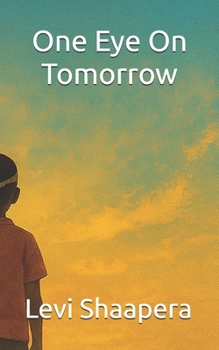
One Eye On Tomorrow

"He lost an eye to darkness-but never lost sight of tomorrow."
From the cracked earth of rural Nigeria to the marble halls of global leadership, One Eye on Tomorrow is a profound and unforgettable literary novel about survival, truth, and transformation. Based on the kind of story that is both too personal and too universal to ignore, this novel invites readers to witness a boy's journey from trauma to transcendence-carving a path not of fame, but of conscience.
Born into poverty, raised in pain, and nearly silenced by loss, Asootar Tarbo enters the world under the flicker of a dying lantern and the shiver of his mother's final breath. His early years are marked by hardship: no classrooms, no clean water, no shoes-just a dream stitched together by chalk and willpower. When an act of neglect leaves him partially blind, Asootar is forced to navigate both a darkened world and a fractured system. But through it all, he holds on to one powerful thing: the belief that brokenness can shine.
From makeshift refugee classrooms to courtroom arguments, political corruption to spiritual awakenings, Asootar's journey is a kaleidoscope of stories stitched together with pain, principle, and poetry. As he rises from silence to speech, from shadow to spotlight, he refuses every call to power that demands he lose his soul. Instead, he turns the spotlight back on the voiceless-the forgotten children, the worn-out teachers, the single mothers, the prisoners of poverty-and dares a broken nation to look at itself.
Told in rich, lyrical prose, One Eye on Tomorrow spans decades, but never loses sight of the child who once sat on mould blocks beneath a leaking roof. Each chapter is a step forward-a ladder from trauma, a ripple of reform, a bridge between past and future. Along the way, we meet unforgettable characters: the nurse who cradled him in crisis; the teacher who believed before the world did; the old man who gave him baby formula and hope; the girl with one eye and no voice, who speaks volumes in silence.
This is more than fiction. It is mirror and memory, both fiction and fate.
Themes woven into the story include:
Educational inequality and hope in hopeless places
Moral leadership versus political ambition
Legacy, loss, and healing from trauma
African identity, resilience, and intergenerational strength
Faith, family, and choosing conscience over convenience
Customer Reviews
ThriftBooks ® and the ThriftBooks ® logo are registered trademarks of Thrift Books Global, LLC
