


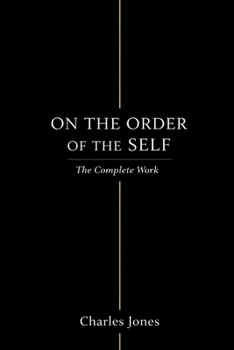
On the Order of the Self: The Complete Work

Every life is lived according to an order.
Whether consciously chosen or unconsciously inherited, no one exists without orientation. The question is not whether your life is ordered, but by what it is ordered, and whether that order can endure.
On the Order of the Self: The Complete Work is not a book about self-improvement. It is a work of examination. It begins with a simple observation: most people pursue purpose without first asking whether that purpose can sustain meaning. Over time, this misalignment produces fragmentation. Effort increases, but coherence does not.
This volume brings together three distinct but unified works:
On the Order of the Self establishes the structure of the human person, examining the emotional, logical, and integrating aspects of the self, and revealing why no part can sustain coherence on its own.At the Limit of the Self moves from structure to lived reality, tracing what occurs when responsibility, suffering, and pressure exceed the capacity of the self to justify its own existence. It exposes the point at which every self-derived purpose collapses.Living in Order serves as a companion guide, helping the reader recognize dissonance, understand its source, and begin orienting toward a life that holds under strain.Taken together, these works follow a single trajectory:
structure → limit → alignment
The claim is not emotional, but structural. The self cannot serve as both the standard and the subject without eventually collapsing under contradiction. Emotion fluctuates. Reason recalculates. Meaning shifts under pressure. Without a stable reference point, coherence becomes conditional.
This book does not ask the reader to accept that conclusion prematurely. It invites careful observation. It traces the boundary where self-sufficiency fails and examines whether a fixed reference exists that can sustain alignment across changing circumstances.
The answer presented is not philosophical invention, but biblical clarity. Christ is introduced not as abstraction or sentiment, but as the only reference that does not shift under weight. In Him, emotion is ordered, reason is directed, and the self is no longer required to generate its own justification.
This is not a call to strive harder. It is a call to stand rightly ordered.
The reader should not expect motivational language or quick resolution. This work is intentionally restrained. It does not attempt to persuade through intensity. It aims to clarify what is already present, often unnamed, within the reader's own experience.
The central question remains:
What orders your life, and does that order hold?
Customer Reviews
ThriftBooks ® and the ThriftBooks ® logo are registered trademarks of Thrift Books Global, LLC
