


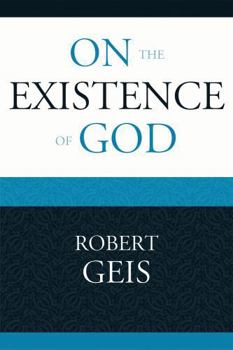
On the Existence of God
No Customer Reviews

The existence of God raises many questions. Geis' work addresses queries that arise from the gratuitous claims of empiricism in Hume, unfounded assumptions in Kant, presumptions of science, and the improbabilities it identifies in Darwinism. By focusing on number and proportion as intrinsic to material and atomic constituency, any argument from chance as instrumental to the cosmos' emergence and sustainability becomes invalidated. The arguments from contingency and the nature of intellection provide more clarity than the ratio Anselmi for acknowledging a transcendent causality, taking the reader to the problem of evil and present-day nihilism. These concepts present great, but not insuperable, difficulty for theism. Geis argues that evil, when one uses it as a means to the betterment of oneself and the world, takes on the r le commensurate with the doctrine of an omnibenevolent deity. Accordingly, one can use evil as a means to a greater understanding of God, Providence, and eternal destiny.
Format:Paperback
Language:English
ISBN:0761849130
ISBN13:9780761849131
Release Date:November 2009
Publisher:University Press of America
Length:236 Pages
Weight:0.80 lbs.
Dimensions:0.7" x 5.9" x 8.9"
Customer Reviews
0 rating
Copyright © 2026 Thriftbooks.com Terms of Use
| Privacy Policy | Do Not
Sell/Share My Personal Information | Cookie Policy | Cookie Preferences | Accessibility Statement
ThriftBooks® and the ThriftBooks® logo are registered trademarks of Thrift Books Global, LLC
ThriftBooks® and the ThriftBooks® logo are registered trademarks of Thrift Books Global, LLC
