
Skip to content
Scan a barcode
Scan
Paperback On the Edge of Reason Book

ISBN: 0811222047

ISBN13: 9780811222044

On the Edge of Reason

Select Format

Select Condition ThriftBooks Help Icon

Recommended

Format: Paperback

Condition: New

$14.39
Save $2.56!
List Price $16.95
On Backorder
If the item is not restocked at the end of 90 days, we will cancel your backorder and issue you a refund.
Usually restocks within 90 days

Book Overview

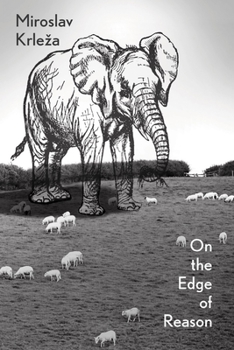
Until the age of fifty-two, the protagonist of On the Edge of Reason suffered a monotonous existence as a highly respected lawyer. He owned a carriage and wore a top hat. He lived the life of "an orderly good-for-nothing among a whole crowd of neat, gray good-for-nothings." But, one evening, surrounded by ladies and gentlemen at a party, he hears the Director-General tell a lively anecdote of how he shot four men like dogs for trespassing on his property. In response, our hero blurts out an honest thought. From this moment, all hell breaks loose.

Written in 1938, On the Edge of Reason reveals the fundamental chasm between conformity and individuality. As folly piles upon folly, hypocrisy upon hypocrisy, reason itself begins to give way, and the edge between reality and unreality disappears.

Customer Reviews

5 ratings

Talented writer; excellent book.

Occasionally one stumbles onto an book or author finding something special. On the Edge of Reason certainly falls into this category for it possesses a quality and intelligence one rarely encounters. Interpretation of the story is difficult simply because it emcompasses so much with Kreleza writing in an omnicient style tending eventually to answer its own questions and resolving every thought by broad consideration and rare insight. Kreleza's perspective in centering his tale on "human folly" seems both original because of unique intelligent presentation, and also age old because certainly human stupidty has been dealt with before. One is reminded of Lear's "stage of fools"; Macbeth's "parade of idiots" and from Henry IV "in everything the purpose must weigh with the folly". The narrator's struggles create a sense of intense deja vu, for we have all been there, maybe in a less protracted sense, but this is simultaneously a story both unique and common. Certainly one keeps coming back as one reads to A Man for All Seasons, as our narrator displays all the attributes of Thomas Moore, in far less heroic style. By the end we find a far broader context than bare human folly, as On the Edge of Reason becomes a complex tale of the dilemas and contradictions one faces in life, with an understated ending that leaves one just shaking the head. It is doubtful, and the reviews seem to indicate this, that one can read on the Edge of Reason without being at least somewhat blown away. The book is that well done, and certainly deserving of much wide recognition.

A classic by one of the world?s great authors

It's unfortunate that so little of Krleza's work has been translated into English. He was among the better writers of the 20th century. "On the Edge of Reason" is an excellent introduction to his work. In this scathing condemnation of the bourgeoisie as Krleza knew it in the last days of the Habsburg Monarchy and interwar Croatia, he describes the downfall of a man for simply speaking his mind. His unnamed protagonist finds himself unwillingly fighting a losing battle against the hypocrisy and self-righteous complacency of the establishment and polite society in a "provincial backwater." I see the reviewers below spent a lot of time comparing Krleza to various other great European authors, although in this book especially his theme much more recalls Sinclair Lewis and his unsparing critique of rural, provincial America in "Main Street." Regardless, this is an excellent book, still fresh and relevant today as it was over 60 years ago when it was first published.

The summit of psycho-political novel

This book ( maybe the word "book" better presents & delineates this impossible genre- a blend of allegory, internal monologue & confession a la Dostoevsky's "Notes", political grotesque surpassing Conrad's "The Secret Agent", sententious wisdom in the vein of Proustian aesthetic sensibility, brutal naturalistic passages worthy of a Zola,..) is a tour de force I don't think it will have ever been equalled in Western fiction.I deliberately didn't delve into detailed analysis of the "plot"- I reckon, maybe the more general description of the work would serve as a better enticement for a wannabe reader.Just this incredible achievement: fusing into a harmonious whole apparently incongruous authors ( I don't mean plagiarism, just sensibility & the way of writing ) like Conrad, Proust, Dostoevsky, Camus, Sologub,..makes one's mind boggle. And more: Krleza has three more novelist masterpieces, one translated ( The Return of Filip Latinowicz ), the other two ( the massive ( circa 700 pages-depends on an edition ) political-allegorical novel "Banquet in Blithuania", plus "summa krleziana", a four-volume psychological/political/historiosophical/meditative "Flags" ).In my opinion, Krleza is so badly rated ( in fact, his prose work rivals Musil or Mann, and surpasses Sartre or Woolf ) that he will never recover in this chaotic, gilded & electronic media-oriented age. Pity. Not for him, but for the age.

"From a Straitjacket Things Have a Different Point of View"

Krleza, a Croat nationalist and Marxist whose best-known works were written in the 1930s, always returns to the theme of human folly as an entropic force that introduces chaos into orderly social systems. This "outlook on life" as the nameless protagonist calls it, depicts the individual struggling against the oppressive corruption of the folly of urban society, which relentlessly grinds him until he succumbs. The protagonist in "On the Edge of Reason" is a fascinating study. At a dinner party he makes an unguardedly honest statement about an important industrialist who years earlier had killed four burglars. He soon finds himself tried and jailed for slander. We watch as he watches his life spiral down into self-induced chaos that he defiantly chooses not to stop, in the name of moral superiority. In the hands of a lesser writer, the story would be a two-dimensional struggle between a heroic and morally attractive individual versus the insidious corrosion of society. Krleza's character is far more nuanced. Convinced of the soundness of his own views, he argues logic and moral righteousness, arguing most stridently when his position is least logical. As his monologue unfolds we more and more doubt his sanity and the reliability of his judgment. The protagonist is not a nice fellow, he has ready excuses for every one of his own reprehensible acts, including a fistfight in the Sistine Chapel, yet he harshly condemns all of the "top-hatted men" who disagree with him.The oppressive and conspiratorial nature of the legal proceedings brings to mind Kafka's "The Trial", except that Krleza's character is fully aware of the runaway nature of events, yet he obstinately chooses to let his own life fall to ruin. The character recalls the nameless protagonist in Dostoevsky's "Notes from Underground", except that Dostoevsky's man was wickedly self-aware, as when he opens that book, "I am a sick man. I am a spiteful man. An unattractive man. I think my liver hurts." Krleza's character could never see himself in such an unflatteringly honest light. He thinks himself well-liked and reasonable, so that when he learns others despise him and his wife has had a lover for years, he is convinced that this is just a sudden bout of hypocrisy by his neighbors, rather than confronting the truth of his own lifelong disagreeableness. He is paranoid, delusional, self-important, and hypercritical of others. And for all that, he hits on some fundamental truths about the cynicism and the dark heart of a civil society that jails him for slander while Domacinski is lionized for multiple murders.This is an excellent book. A disturbing look not only into the heart of a corrupt society, but into the mind of a diseased iconoclast.

A Crossbreed of Erasmus and Dostoyevsky

Imagine a nutcase becoming fully aware of his madness. And from the intersection of the rational and the schizophernic, he muses on the vicissitudes of a kafkaesque bureaucratic terror, on the list of which he deliberalitely engraved his name. Simply from the outburst of provoked common decency and the ineradicable moral whisper within he has been constantly suppressing. What happens next ? Read the book.
Copyright © 2026 Thriftbooks.com Terms of Use | Privacy Policy | Do Not Sell/Share My Personal Information | Cookie Policy | Cookie Preferences | Accessibility Statement
ThriftBooks® and the ThriftBooks® logo are registered trademarks of Thrift Books Global, LLC

GoDaddy Verified and Secured