


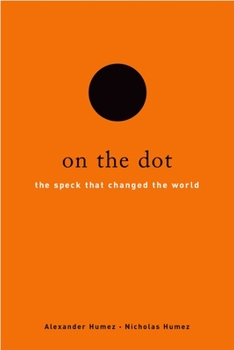
On the Dot: The Speck That Changed the World


Select Format
Select Condition 
Book Overview
Despite the humble origins of its name (Anglo Saxon for the speck at the head of a boil), the dot has been one of the most versatile players in the history of written communication, to the point that it has become virtually indispensable. Now, in On the Dot, Alexander and Nicholas Humez
offer a wide ranging, entertaining account of this much overlooked and minuscule linguistic sign. The Humez brothers shed light on the dot in all its various forms. As a mark of punctuation, they show, it plays many roles--as sentence stopper, a constituent of the colon (a clause stopper), and the ellipsis (dot dot dot). In musical notation, it denotes and a half. In computerese, it has
several different functions (as in dot com, the marker between a file name and its extension, and in some slightly more arcane uses in programming languages). The dot also plays a number of roles in mathematics, including the notation of world currency (such as dollars dot cents), in Morse code
(dots and dashes), and in the raised dots of Braille. And as the authors connect all these dots, they take readers on an engaging tour of the highways and byways of language, ranging from the history of the question mark and its lesser known offshoots the point d'ironie and the interrobang, to
acronyms and backronyms, power point bullets and asterisks, emoticons and the at-sign. Playful, wide-ranging, and delightfully informative, On the Dot reveals how thoroughly the dot is embedded in our everyday world of words and ideas, acquiring a power inversely proportional to its diminutive size.
Format:Hardcover
Language:English
ISBN:0195324994
ISBN13:9780195324990
Release Date:October 2008
Publisher:Oxford University Press, Incorporated
Length:272 Pages
Weight:0.90 lbs.
Dimensions:5.6" x 1.0" x 8.2"
Customer Reviews
2 ratings
Doesn't Get Any Smaller
Published by Thriftbooks.com User , 16 years ago
A book about the dot? Surely it doesn't get more minimalist than that. Yet this ubiquitous little black blip has found its way into music, encoding, abbreviation, punctuation, mathematics, and a host of other domains for as long as people have been writing at all. The Humez brothers are exuberant in their erudition, providing a wealth of the cultural baggage carried by this humble sign, both in the course of their twelve chapters and in their copious and entertaining endnotes. Good to see these chaps writing again: It's been over a decade since their last book, but On the Dot was worth the wait.
A bit of this, a spec of that, ...
Published by Thriftbooks.com User , 17 years ago
Lynne Truss covered punctuation in 204 small pages with fairly wide margins. The Humez brothers devote 160 pages of smaller type and narrower margins to the period. But "On the Dot" is even more fun than "Eats, Shoots & Leaves". It is very little about how to use the period correctly. It is everything there is to know about the dot, including its history, its use in idioms, Morse code, music, law, mathematics, computers, and as a component of other punctuation. To be sure they cover the target completely, they stray into many other domains where dots are used or were used, including the history of the words used in the descriptions and the examples. It is a lot of fun, but sometimes the diversions seem to drag on. The text is well documented, with 49 pages of notes, a 9 page bibliography, and an index of 32 double column pages. Think about those numbers. The notes follow the pattern of the text, frequently wandering into barely related topics. I suspect that most readers would not enjoy this book, but most readers with lots of curiosity and varied interests will like it.
Copyright © 2026 Thriftbooks.com
Terms of Use | Privacy Policy | Do Not Sell/Share My Personal Information | Cookie Notice | Cookie Preferences | Accessibility Statement
ThriftBooks ® and the ThriftBooks ® logo are registered trademarks of Thrift Books Global, LLC
ThriftBooks ® and the ThriftBooks ® logo are registered trademarks of Thrift Books Global, LLC
