


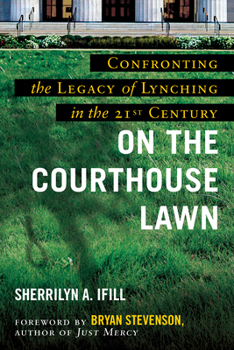
On the Courthouse Lawn: Revised Edition

Select Format
Select Condition 
Book Overview
Nearly 5,000 black Americans were lynched between 1890 and 1960. Over forty years later, Sherrilyn Ifill's On the Courthouse Lawn examines the numerous ways that this racial trauma still resounds across the United States. While the lynchings and their immediate aftermath were devastating, the little-known contemporary consequences, such as the marginalization of political and economic development for black Americans, are equally pernicious. On the Courthouse Lawn investigates how the lynchings implicated average white citizens, some of whom actively participated in the violence while many others witnessed the lynchings but did nothing to stop them. Ifill observes that this history of complicity has become embedded in the social and cultural fabric of local communities, who either supported, condoned, or ignored the violence. She traces the lingering effects of two lynchings in Maryland to illustrate how ubiquitous this history is and issues a clarion call for American communities with histories of racial violence to be proactive in facing this legacy today. Inspired by South Africa's Truth and Reconciliation Commission, as well as by techniques of restorative justice, Ifill provides concrete ideas to help communities heal, including placing gravestones on the unmarked burial sites of lynching victims, issuing public apologies, establishing mandatory school programs on the local history of lynching, financially compensating those whose family homes or businesses were destroyed in the aftermath of lynching, and creating commemorative public spaces. Because the contemporary effects of racial violence are experienced most intensely in local communities, Ifill argues that reconciliation and reparation efforts must also be locally based in order to bring both black and white Americans together in an efficacious dialogue. A landmark book, On the Courthouse Lawn is a much-needed and urgent road map for communities finally confronting lynching's long shadow by embracing pragmatic reconciliation and reparation efforts.
Format:Paperback
Language:English
ISBN:0807023043
ISBN13:9780807023044
Release Date:August 2018
Publisher:Beacon Press
Length:240 Pages
Weight:0.88 lbs.
Dimensions:0.7" x 5.9" x 8.9"
Related Subjects
20th Century 21st Century African-American Studies Contemporary Discrimination & Racism History Law Literary Literature & Fiction Minority Studies Politics & Social Sciences Race Relations Social Science Social Sciences Specific Demographics State & Local True Crime Violence in SocietyCustomer Reviews
4 ratings
Excellent analysis and engaging writing
Published by Thriftbooks.com User , 16 years ago
A gripping account that shines a bright, incisive light on a shameful and denied history.
On the Courthouse Lawn
Published by Thriftbooks.com User , 18 years ago
Sad but true and still happening in many places of America. I have passed this book along and repurchased it for my library. A must read if you care about the future of America and the world.
A must read for blacks as well as whites.
Published by Thriftbooks.com User , 18 years ago
An excellent account of a violent period of African American history. Professor Ifill's research and fact finding accounts gave her a unique prospective into a dark area of American "culture" that many have tried to ignore or surpress.
Highly recommended!
Published by Thriftbooks.com User , 18 years ago
In the aftermath of Michael Richards' racist meltdown in 2006, I found it curious that outrage focused primarily on his spewing of the n-word, whereas his casual reference to his alleged heckler being a candidate for lynching not long ago drew comparatively little comment in the white media. Then again, perhaps it's not surprising. Nearly 5,000 black Americans were lynched between 1890 and 1960, and the prevailing perception in white communities is of clandestine acts perpetrated by a handful of outside agitators and "bad apples." But in reality, as Sherrilyn Ifill clearly documents, lynchings were public spectacles, community events cheered on by large crowds of people from all walks of life - often quite literally on the courthouse lawn, and photographed for posterity. The conspiracy of silence (or "passive postlynching complicity") ensured that not a single perpetrator was ever brought to justice for the heinous crimes, and white supremacy was reinforced. In the first part of the book, Ifill lays a foundation by exploring the history of lynchings and near lynchings on the Eastern Shore of Maryland in the 1930's, and discusses the legacy of this racial trauma on both white and black communities. The second part examines techniques for racial reconciliation and reparation, including those of South Africa's Truth and Reconciliation Commission, and suggests a roadmap for communities interested in restorative justice, which requires honest and open communication not only among races but within them. A civil rights lawyer and professor, Ifill's writing is clear, concise and compelling. This is more like a conversation with a friend than a lecture from a professor, and despite the painful subject matter, I found it hard to put down. Highly recommended!
Copyright © 2026 Thriftbooks.com Terms of Use
| Privacy Policy | Do Not
Sell/Share My Personal Information | Cookie Policy | Cookie Preferences | Accessibility Statement
ThriftBooks® and the ThriftBooks® logo are registered trademarks of Thrift Books Global, LLC
ThriftBooks® and the ThriftBooks® logo are registered trademarks of Thrift Books Global, LLC
