


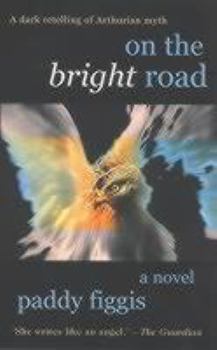
On the Bright Road


Clever, urgent and uncompromisingly individual.?The Observer Convinced that he is dying, Cathal Kerr retreats into his lonely cottage, preoccupied with the workings of his own mind and spirit. Meanwhile, in the wood above Cathal's desolate home, in a time overlapping the present, a sixth-century woodsman, the Tracker, watches the movement of beast and man. The road running nearby follows the old Roman highway, transformed by legend into The Bright Road. What happens when Cathal's world comes into contact with an age long gone? Who will survive when men and armies clash on the Bright Road? Could this be the end of one man's universe ... or the beginning of another's? On The Bright Road follows the dark transmigration of a soul into the bleak, shifting landscapes of Celtic Wales. "A writer of real power."?The Sunday Times Paddy Figgis lives in Powys, Wales. She is the author of three novels, including Ribstone Pippins, which were published by Marion Boyars under the name Helen Wykham. Her novel, The Fourth Mode, appeared under the name N. P. Figgis. She has also produced a large number of articles and monographs relating to Welsh archaeology.
Format:Paperback
Language:English
ISBN:0714530573
ISBN13:9780714530574
Release Date:July 2000
Publisher:Marion Boyars Publishers
Length:250 Pages
Weight:0.68 lbs.
Dimensions:0.8" x 5.3" x 8.5"
Customer Reviews
1 rating
Atypical "dark ages" novel of identity fragmentation
Published by Thriftbooks.com User , 20 years ago
Certainly a challenging, difficult, and ambiguous novel. As the blurb for the book on this site summarizes, this combines two stories, one from the Arthurian, post-Roman era and one from today, set in 1993. Figgis reminds me of Charles Williams' own difficult fiction (she cites him in a quote), which likewise sought to merge the supernatural plane with our own mundane. Her knowledge of archeology and the "dark ages" of Britain makes for the most involving aspect of this tangled tale. She delays, like a crafty storyteller, clarifying details of the story until much later than a reader might expect, and even at its close, this novel leaves spaces still unfilled. Its unforgiving erudition makes this at all times a daunting rather than diverting read, and it's a very serious story, with not much humor or wit to lighten its considerably relentless gloom. It deserves a more educated reader than I am to excavate and label all of its layered artifacts. Figgis labors to re-create not only the decay of post-Roman Wales but the decline of one modern man's life, and the parallels, although never obviously juxtaposed, make for instructive insights, which she does not--to her credit but relying upon the reader's consistent and not entirely rewarded effort--simplify or reduce to truisms. While I expected an easier novel, this does show that Figgis takes her audience as seriously as she does her fiction, and this is probably a step above the usual Arthurian fantasy. My one criticism is that I sensed that secondary characters remained too willfully mysterious throughout, and the lack of explanation for many of the more mundane events--as well as those more symbolic--irritated me. Figgis does not provide enough clues to unlock all of the puzzles she places within the way of Kerr's quest, for him or for us. More disturbing, unsettled in its characterization, and opaque in what would have been in other novels clues that would have been eventually made transparent, her novel may frustrate more likely than entertain. She knows a great deal about the time she restores here, Arthur is by the way off-stage rather than the protagonist, and both The Tracker and Cathal Kerr remain enigmatic central characters beyond the last pages of what does not reach simple closure as a conventional "time-travel" tale.
Copyright © 2026 Thriftbooks.com Terms of Use
| Privacy Policy | Do Not
Sell/Share My Personal Information | Cookie Policy | Cookie Preferences | Accessibility Statement
ThriftBooks® and the ThriftBooks® logo are registered trademarks of Thrift Books Global, LLC
ThriftBooks® and the ThriftBooks® logo are registered trademarks of Thrift Books Global, LLC
