


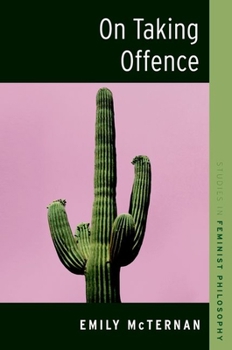
On Taking Offence
No Customer Reviews

Someone fails to shake your outstretched hand, puts you down in front of others, or makes a joke in poor taste. Should we take offence? Wouldn't it be better if we didn't? In the face of popular criticism of people taking offence too easily, and the social problems that creates, Emily McTernan defends taking offence as often morally appropriate and socially valuable. Within societies marred by inequality, taking offence can resist the day-to-day patterning of social hierarchies. This book defends the significance of details of our social interactions. Cumulatively, small acts, and the social norms underlying these, can express and reinforce social hierarchies. But by taking offence, we mark an act as an affront to our social standing. We also often communicate our rejection of that affront to others. At times, taking offence can be a way to renegotiate the shared social norms around what counts as respectful treatment. Rather than a mere expression of hurt feelings then, to take offence can be to stand up for one's standing. When taken by those deemed to have less social standing, to take offence can be a direct act of insubordination against a social hierarchy. Taking offence can resist everyday inequalities. In unequal societies, the inclination to take offence at the right things, and to the right degree, may even be a civic virtue. These right things at which to take offence include many of the very instances that the opponents of a culture of taking offence find most objectionable: apparently trivial and small-scale details of our social interactions.
Format:Hardcover
Language:English
ISBN:0197613098
ISBN13:9780197613092
Release Date:May 2023
Publisher:Oxford University Press, USA
Length:208 Pages
Related Subjects
PhilosophyCustomer Reviews
0 rating
Copyright © 2026 Thriftbooks.com
Terms of Use | Privacy Policy | Do Not Sell/Share My Personal Information | Cookie Policy | Cookie Preferences | Accessibility Statement
ThriftBooks ® and the ThriftBooks ® logo are registered trademarks of Thrift Books Global, LLC
ThriftBooks ® and the ThriftBooks ® logo are registered trademarks of Thrift Books Global, LLC
