


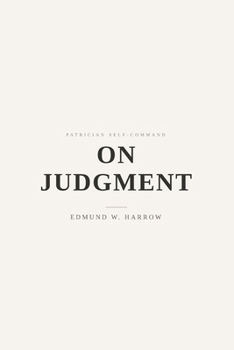
On Judgment: Terms, Standards, and the Shape of a Decision
No Customer Reviews

Judgment is not a mood, and not a preference. It is a settled act of mind by which a person assigns a thing its due weight under a stated measure, in view of an end, and with regard for consequence. This volume orders the basic terms that make judgment possible. It distinguishes judgment from opinion and impulse, and it separates the language of decision from the language of reaction. The aim is not to decorate thought, but to give it a stable grammar. The book clarifies what a judgment is about, what counts as a standard, how purposes govern selection, and why consequences belong to the form of a decision rather than to its later narration. It treats terms as instruments of rule: when words are loose, responsibility becomes vague; when words are exact, responsibility can be borne. The chapters proceed by definition and distinction, with brief examples where they serve precision. They address measure and standard, purpose and end, cause and condition, evidence and weight, boundaries of definition, alternatives and trade, consequence and responsibility, and the limits set by time, irreversibility, risk, and uncertainty. This book is for readers who must decide under pressure and who prefer clear terms to expressive commentary. It is not for those seeking confession, therapeutic language, or a catalogue of techniques. It belongs to the line Patrician Self-Command, which treats self-rule as a matter of disciplined language, ordered thought, and quiet responsibility.
Format:Paperback
Language:English
ISBN:B0GYGVZ4M8
ISBN13:9798258694652
Release Date:April 2026
Publisher:Independently Published
Length:262 Pages
Weight:0.78 lbs.
Dimensions:0.6" x 6.0" x 9.0"
Related Subjects
Business Business & Investing Philosophy Self Help Self-Help Self-Help & PsychologyCustomer Reviews
0 rating
Copyright © 2026 Thriftbooks.com
Terms of Use | Privacy Policy | Do Not Sell/Share My Personal Information | Cookie Notice | Cookie Preferences | Accessibility Statement
ThriftBooks ® and the ThriftBooks ® logo are registered trademarks of Thrift Books Global, LLC
ThriftBooks ® and the ThriftBooks ® logo are registered trademarks of Thrift Books Global, LLC
