


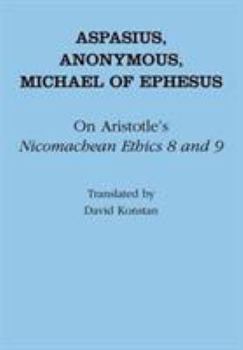
On Aristotle's "nicomachean Ethics 8 and 9"

No Synopsis Available.
Format:Hardcover
Language:English
ISBN:080143906X
ISBN13:9780801439063
Release Date:October 2001
Publisher:Cornell University Press
Length:240 Pages
Weight:1.19 lbs.
Dimensions:0.9" x 6.4" x 9.5"
Related Subjects
PhilosophyCustomer Reviews
1 rating
We Reach Our Complete Perfection Through Habit
Published by Thriftbooks.com User , 17 years ago
I read this book for a graduate seminar on Aristotle. I think Aristotle's ethics is his most seminal work in philosophy. In the early 1960's virtue ethics came to fore. It is a retrieval of Aristotle. It has very close parallels to the ancient Chinese philosophy of Confucius and the modern philosophy espoused in the 1970's called Communitarianism. For Aristotle Nicomachean Ethics, (EN) is about human life in an embodied state. Area of inquirery for EN is "good" this is his phenomenology. What does "good" mean? He suggests good means "a desired end." Something desirable. Means towards these ends. Such as money is good, so one can buy food to eat because "eating is good." In moral philosophy distinction between "intrinsic good" vs. "instrumental good." Instrumental good towards a desire is "instrumental good" like money. Thus, money is an "instrumental good" for another purpose because it produces something beyond itself. Instrumental good means because it further produces a good, "intrinsic good" is a good for itself, "for the sake of" an object like money. "Intrinsic good" for him is "Eudemonia=happiness." This is what ethics and virtues are for the sake of the organizing principle. Eudemonia=happiness. Today we think of happiness as a feeling. It is not a feeling for Aristotle. Best translation for eudaimonia is "flourishing" or "living well." It is an active term and way of living for him thus, "excellence." Ultimate "intrinsic good" of "for the sake of." Eudaimonia is the last word for Aristotle. Can also mean fulfillment. Idea of nature was thought to be fixed in Greece convention is a variation. What he means is ethics is loose like "wealth is good but some people are ruined by wealth." EN isn't formula but a rough outline. Ethics is not precise; the nature of subject won't allow it. When you become a "good person" you don't think it out, you just do it out of habit! You can have ethics without religion for Aristotle. Nothing in his EN is about the afterlife. He doesn't believe in the universal good for all people at all times like Plato and Socrates. The way he thought about character of agent, "thinking about the good." In addition, Aristotle talked about character traits. Good qualities of a person who would act well. Difference between benevolent acts and a benevolent person. If you have good character, you don't need to follow rules. Aretç=virtue, in Greek not religious connotation but anything across the board meaning "excellence" high level of functioning, a peak. Like a musical virtuoso. Ethical virtue is ethical excellence, which is the "good like." In Plato, ethics has to do with quality of soul defining what to do instead of body like desires and reason. For Aristotle these are not two separate entities. To be good is how we live with other people, not just focus on one individual. Virtue can't be a separate or individual trait. Socrates said same the thing. Important concept for
Copyright © 2026 Thriftbooks.com Terms of Use
| Privacy Policy | Do Not
Sell/Share My Personal Information | Cookie Policy | Cookie Preferences | Accessibility Statement
ThriftBooks® and the ThriftBooks® logo are registered trademarks of Thrift Books Global, LLC
ThriftBooks® and the ThriftBooks® logo are registered trademarks of Thrift Books Global, LLC
