


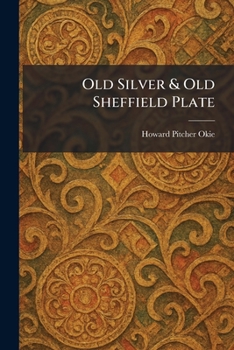
Old Silver & Old Sheffield Plate

Select Format
Select Condition 
Book Overview
"Old Silver & Old Sheffield Plate" is a comprehensive and authoritative reference work dedicated to the identification, history, and appreciation of antique silverware and silver-plated items. Written by Howard Pitcher Okie, this exhaustive study serves as an essential resource for collectors, historians, and enthusiasts of the decorative arts. The book provides a detailed examination of both genuine silver and the specialized fusion process known as Sheffield plating.
A core strength of this work is its extensive catalog of hallmarks. It includes thousands of marks from Great Britain, Ireland, and continental Europe, providing the necessary tools for readers to trace the origins, production dates, and specific makers of various silver pieces. Beyond mere identification, the text explores the technical craftsmanship and stylistic evolution of silverwork, offering insights into the cultural and economic factors that shaped these objects through the eighteenth and nineteenth centuries.
With its systematic approach and historical depth, "Old Silver & Old Sheffield Plate" remains a foundational guide for anyone seeking to authenticate or value antique metalwork. It successfully bridges the gap between a technical manual and an art history text, celebrating the enduring beauty and expert craftsmanship of these treasured historical artifacts.
This work has been selected by scholars as being culturally important, and is part of the knowledge base of civilization as we know it. This work was reproduced from the original artifact, and remains as true to the original work as possible. Therefore, you may see the original copyright references, library stamps (as most of these works have been housed in our most important libraries around the world), and other notations in the work.
This work is in the public domain in the United States of America, and possibly other nations. Within the United States, you may freely copy and distribute this work, as no entity (individual or corporate) has a copyright on the body of the work.
As a reproduction of a historical artifact, this work may contain missing or blurred pages, poor pictures, errant marks, etc. Scholars believe, and we concur, that this work is important enough to be preserved, reproduced, and made generally available to the public. We appreciate your support of the preservation process, and thank you for being an important part of keeping this knowledge alive and relevant.
Customer Reviews
ThriftBooks ® and the ThriftBooks ® logo are registered trademarks of Thrift Books Global, LLC
