


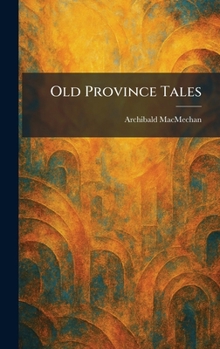
Old Province Tales

"Old Province Tales" is a captivating collection of historical narratives that bring to life the rugged and storied past of Nova Scotia. Authored by the esteemed scholar Archibald MacMechan, this work delves into the maritime heritage and local legends of the Canadian Maritimes, offering readers a window into a bygone era. Through a series of meticulously researched and elegantly told stories, MacMechan explores the high stakes of the age of sail, including harrowing accounts of shipwrecks, the daring exploits of privateers, and the resilience of those who settled the Atlantic coast.
The book captures the unique spirit of the "Old Province," blending factual historical detail with a literary flair that highlights the romance and danger of the sea. From the trials of early pioneers to the mysteries of the deep, "Old Province Tales" serves as both a historical record and a tribute to the coastal identity of North America. This collection remains an essential read for those interested in Canadian history, maritime lore, and the enduring power of regional storytelling. Its vivid depictions of Nova Scotian life and its seafaring traditions continue to resonate with historians and general readers alike, preserving the legacy of the North Atlantic's maritime culture.
This work has been selected by scholars as being culturally important, and is part of the knowledge base of civilization as we know it. This work was reproduced from the original artifact, and remains as true to the original work as possible. Therefore, you may see the original copyright references, library stamps (as most of these works have been housed in our most important libraries around the world), and other notations in the work.
This work is in the public domain in the United States of America, and possibly other nations. Within the United States, you may freely copy and distribute this work, as no entity (individual or corporate) has a copyright on the body of the work.
As a reproduction of a historical artifact, this work may contain missing or blurred pages, poor pictures, errant marks, etc. Scholars believe, and we concur, that this work is important enough to be preserved, reproduced, and made generally available to the public. We appreciate your support of the preservation process, and thank you for being an important part of keeping this knowledge alive and relevant.
Customer Reviews
ThriftBooks ® and the ThriftBooks ® logo are registered trademarks of Thrift Books Global, LLC
