
Skip to content
Scan a barcode
Scan
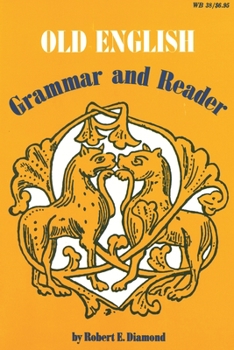
Paperback Old English: Grammar and Reader Book

ISBN: 0814315100

ISBN13: 9780814315101

Old English: Grammar and Reader

Select Format

Select Condition ThriftBooks Help Icon

Recommended

Format: Paperback

Condition: Good

$11.09
Save $14.90!
List Price $25.99
Almost Gone, Only 2 Left!
Save to List

Book Overview

This book makes learning Old English easy. It contains a simplified grammar, a minimum of phonology, well-chosen selections from Old English prose, and rich selections from Old English poetry. The texts are in regularized spelling, based on Early West Saxon, so that beginners will not have to wrestle with a shifting orthography. All texts come with facing-page literal translations.

The prose selections include: "The Voyages of Ohthere and Wulfstan"; "The Story of King Cynewulf of Wessex"; "The Wars of King Alfred against the Vikings"; and King Alfred's Preface to Cura Pastoralis. The poetry includes: Caedmon's "Hymn" from Bede's Ecclesiastical History of the English People; The Battle of Brunanburg; The Battle of Maldon; The Dream of Rood from the Vercelli Book; The Wanderer, The Seafarer, The Wife's Lament, The Storm Riddles, The Panther, and The Whale from The Exeter Book.

Customer Reviews

5 ratings

Old English Grammar and Peter Baker's Introduction to Old English

I bought both Prof. Diamond's Old English Grammar and Prof. Baker's Introduction to Old English after checking them out from my local library. They are both excellent works, but I prefer Prof. Diamond's book for a couple of reasons. First, although trivial, I have learned other inflected languages such as Greek and Latin and they always present noun declensions for the various cases in the following order: nominative, genitive, dative, accusative, ablative, etc. Prof. Diamond presents noun declensions in the same way while Prof. Baker's book presents them in the order nominative, accusative, genitive, dative, etc. It throws me off just enough to be irritating when I am trying to memorize the case endings. Second, as mentioned in other reviews, Prof. Diamond presents translations with each text. This makes it possible to learn a few words and them jump straight into the texts without having to guess whether or not you understood the various pieces. Prof. Baker's book has its merits such as its companion website and its more detailed discussion of grammar, but I would recommend starting to learn Old English with Prof. Diamond's book. One more point - if you are considering buying both keep in mind that many of the literary samples in both overlap so if you buy Prof. Baker's book you should buy it because you want a better understanding of grammar not because you want more samples of Old English.

Old English Made Easy...

This is the first Old English grammar I studied, nearly 25 years ago, and it remains perhaps the best one-volume introduction to Old English around. Concise, simple, and accessible, this text has both a reader and a grammar in one cover, containing selections from the major Old English poems and prose works. The prose works include 'The Voyages of Ohthere and Wulfstan', selections from the Anglo-Saxon Chronicle, and the preface by Alfred the Great to the medieval work on Pastoral Care by Pope Gregory. There are relatively few Old English prose works that have survived into the present day; there are even fewer authentically Old English pieces, as many Old English prose works are in fact translations of Latin pieces, and for some reason adapted their grammar to the Latin original rather than the Old English natural pattern. The poetry exhibits the paired-verse pattern (although the translations accompanying them do not strive to keep the metrical pattern). The poetry include majors works such as Caedmon's Hymn, The Battle of Brunanburg, The Battle of Maldon, The Wanderer, The Seafarer, maxims, riddles, and other poems. There is no Beowulf contained here, nor any other heroic poems (such as Deor), as Diamond states that these are the most likely follow-up readings after one gains a grounding in Old English, and the poems contained here are often overlooked by students save for the most dedicated of scholars. The texts here are normalised to Early West Saxon dialect, with a grammar very simplified; concepts are introduced that are directly useful for the texts contained herein. The glossary is similarly normalised, and cross-referenced for various verb forms and other vocabulary links such as prefixes and alternatives. In a remarkable insight on how students use texts, Diamond states that, for the purposes of this introductory text, notes have been eliminated, as students rarely refer to them anyway. The section on metrics introduces the five principle types of verses, as well as some minor variations. Diamond includes a brief bibliography with dictionaries, grammars, commentaries and more; this is now somewhat out of date, but also shows the slow pace at which some aspects of Old English scholarship proceed, with references going back to volumes published in the late 1800s. A very useful and fun text from which to learn!

Within a year I could read Beowulf

This text, in conjunction with Robinson's 'Old English and its Closest Relatives' (which you may want to read first if you're a monolingual English speaker)brings the world of early Germanic language and culture into a sharper focus. I feel that Old English is an essential study for anyone interested in Germanic languages. It serves as a solid base by which languages like Gothic and Old Norse are more easily and quickly understood.

A Unique and Very Helpful Little Book

This is the only book for Anglo-Saxon that I know of, besides some editions of Beowulf, which has PARALLEL TEXTS for all of the readings. This is a huge help and will save you a whole lotta knock-shloggin' (looking words up), so you can study Old English kicked back with your feet up. Plus, the translations are nice and literal, and where they can't be literal, the translator gives the word-for-word meaning in parentheses. Another nice thing is that, unlike most all other Old English readers, none of the selections here are translations of Latin works (and so not influenced by annoying Latin syntax), but all original Anglo-Saxon compositions, including some of the most important works: Caedmon's Hymn, The Battle of Brunanburg, The Battle of Maldon, The Dream of the Rood, The Wanderer, The Seafarer, The Wife's Lament, The Whale, selections from The Anglo-Saxon Chronicle (Alfred vs. the Vikings--hooray!), and others. Mr. Diamond says that this book "is intended to make learning Old English as easy as possible", and he does a great service by publishing it. True, there are no lessons or exercises, but if you've been studying your German or your Icelandic then you'll have no problem with the very to-the-point treatments of grammar, Umlaut, metrics, etc. (If, on the other hand, you haven't been working on your modern German, then what the heck are you already jumping to Old English for?!) This book, good also for review, will get you reading Anglo-Saxon texts very soon if not immediately, and the mix in them of a hardy Germanic character and a very familiar Englishness is pure pleasure. (P.S. If you want a really helpful edition of Beowulf, get George Jack's (OUP), and if you want a nice overview of all Old Germanic, try Robinson's Old English and its Closest Relatives.)

OE Grammar and Reader

Excellent for use with, for example, the new Beowulf translation. Diamond does a good job providing a nice balance between pronunciation, grammar, readings, and a dictionary. The dictionary could be longer, and I am sure our knowledge has progressed since 1973 (another edition, Robert?) but overall this book achieves very well what it sets out to do: provide a nice introduction to OE.
Copyright © 2026 Thriftbooks.com Terms of Use | Privacy Policy | Do Not Sell/Share My Personal Information | Cookie Policy | Cookie Preferences | Accessibility Statement
ThriftBooks ® and the ThriftBooks ® logo are registered trademarks of Thrift Books Global, LLC

GoDaddy Verified and Secured