


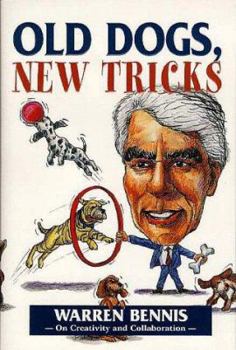
Old Dogs, New Tricks: On Creativity and CollaborationBennis

Select Format
Select Condition 
Book Overview
In today's dog-eat-dog world of competition and ongoing change, people in every position, especially the "old dogs," must learn to work as great groups and creative coalitions rather than as "lone... This description may be from another edition of this product.
Format:Hardcover
Language:English
ISBN:1890009342
ISBN13:9781890009342
Release Date:May 1999
Publisher:Executive Excellence Publishing
Length:360 Pages
Weight:1.00 lbs.
Dimensions:9.5" x 0.8" x 6.3"
Customer Reviews
1 rating
Old Wine, New Bottle
Published by Thriftbooks.com User , 24 years ago
Bennis has written almost 30 books thus far, most of them on the subject of leadership. Those who have already read several of them will find no "new tricks" in this book and may, in fact, share my discomfort with any use of the word "tricks" other than in the quite specific "old dogs" context. The last thing our world needs is having more tricksters in positions of leadership but we do need leaders who inspire in others (in Bennis' words) "a sense of purpose or meaning...a sense of belonging, community, team, or group....[and] a sense of power, involvement, connection, and alliance" In another book, Bennis draws a comparison between managing people and herding cats. Some day, I hope he will write a book (perhaps dedicated to Noah) in which he suggests what can be learned from both the male and female lion as well as from the termite, the orca whale, alligators and crocodiles, the prairie dog, the hyena, etc. For Bennis, the "new trade is all about vision, meaning, purpose, and trust -- and what it takes to maintain these essential elements in modern organizations." I assume he agrees with me that only a few can occupy the highest executive levels in an organization (CEO, COO, CFO, etc.) but literally everyone in the same organization can be a leader in the sense of taking appropriate (repeat, "appropriate") initiatives. They will do so, however, only if their organization's leaders "have the capacity to enroll [them]" in a compelling vision. In Section 3, Bennis identifies and then explains several strategies which are needed to achieve that engagement:1. Release the brainpower of people2. Work for the long-term interests of all stakeholders3. Adapt to a new style of leadership4. Form new global alliancesNOTE: For small-to-midsize organizations, this probably involves forming strategic alliances with other, much larger organizations which are global in both their nature and scope.5. Reinvent the organization6. Solve problems before they have names7. For everyone involved, be a leader of leaders8. Share the power [i.e. share authority as well as responsibility]9. Make the case for co-leaders10. Create leaders at every levelNOTE: Noel Tichy has a great deal of value to say about #10 in The Leadership Engine. I also highly recommend Bennis and Goldsmith's Learning to Lead. If massive organizational transformation is required, I recommend O'Toole's Leading Change and Katzenbach's Real Change Leaders. In his Postscript, Bennis discusses the importance of authenticity. Without it, there can be no mutual trust and respect, nor cooperation (much less what Bennis calls "creative collaboration"), nor any possibility of completing the transition to the New Trade. "Tomorrow's organizations will be federations, networks, clusters, cross-functional teams, temporary systems, ad hoc task forces, lattices, modules, matrices -- almost anything but pyramids. An organizations can become and then remain "authentic" only to the extent that its people (especially its
Copyright © 2026 Thriftbooks.com Terms of Use
| Privacy Policy | Do Not
Sell/Share My Personal Information | Cookie Policy | Cookie Preferences | Accessibility Statement
ThriftBooks® and the ThriftBooks® logo are registered trademarks of Thrift Books Global, LLC
ThriftBooks® and the ThriftBooks® logo are registered trademarks of Thrift Books Global, LLC
