


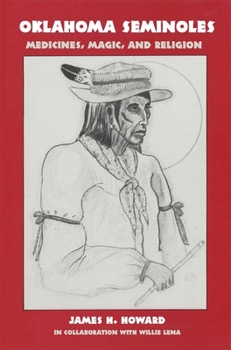
Oklahoma Seminoles: Medicines, Magic, and Religion Volume 166

Select Format
Select Condition 
Book Overview
Mention the name Seminole and most Americans think of the Florida segment of the tribe--Indian men in colorful shirts poling dugouts through the black waters of the Everglades and women sewing patchwork in palmetto-thatched chickees. But another Seminole population, much larger in numbers, lives in the prairie and scrub oak hill country of Oklahoma. Studies of the Oklahoma segment of the tribe have been few, and James H. Howard's objective in writing this book has been to record the richness of Seminole culture in the West, presenting that culture as it is seen and interpreted by its more traditional members in Oklahoma today. Much of the Seminole culture is held in common, but many differences have grown up between the two groups since the "Trail of Tears" separated them in the 1830s. This does not necessarily mean greater acculturation to white ways by the Oklahoma Seminoles. In some instances the Oklahomans are the more traditional, in that they retain cultural forms mentioned in early records but long forgotten in Florida. Howard documents contributions from many persons, but the greatest amount of information came from Willie Lena, a Seminole town chief who lives in Wewoka, Oklahoma. Born in 1912 and reared by his conservative grandparents, Lena was shielded from the white culture during his childhood and carefully trained in Seminole ways and values. Recognized since his youth as a traditionalist leader, Lena has a lively intelligence, artistic talent, and a warm personality that have led him to serve as an enthusiastic ambassador of his own culture both to the younger generation of Seminoles and Creeks and to non-Indians as well. In a detailed report of Seminole culture as it is found in Oklahoma today, Howard has included chapters on herbal and non-herbal remedies, magic and witchcraft, supernaturals, the Green Corn Ceremony, the nighttime dances and other ceremonials, sports and games, mortuary practices, and other aspects of the Seminole world. Based on firsthand information and extensive fieldwork, Howard's descriptions are appealing and immediate. He also displays extensive knowledge of the related literature, and parallel material recorded in earlier sources is often cited for comparison. Lena's illustrations add further interest and authenticity to the book. Seminole culture, with its unique attitudes and beliefs and distinctly Southeastern Indian worldview, has persisted in spite of more than four hundred years of exposure to European and American culture. It is quite clear from the material presented in this book that there will continue to be American Indians in Oklahoma who proudly call themselves "Seminole" for many years to come.
Format:Paperback
Language:English
ISBN:0806122382
ISBN13:9780806122380
Release Date:May 1984
Publisher:University of Oklahoma Press
Length:304 Pages
Weight:0.85 lbs.
Dimensions:0.9" x 5.5" x 8.3"
Customer Reviews
2 ratings
Excellent resource
Published by Thriftbooks.com User , 22 years ago
Having known both James and Willie was a priviledge. This book provides some wonderful insight into the life and philosphy of Willie Lena and his belief system as a tradtional Oklahoma Seminole. Willie was a tremendous artist (many of his illustrations are included in the book)and used his skill to capture Seminole material culture, social and ceremonial practices. Is the book flawless? No. However, James did an excellent job telling the story from Willie's viewpoint. If you are interested in Oklahoma Creek/Seminole culture, read the book.
Sacred Ways of Seminole
Published by Thriftbooks.com User , 22 years ago
What James Mooney's "History, Myths and Sacred Formulas of the Cherokee" did for the Cherokee, this book does for the Oklahoma Seminole. Another excellent book in University of Oklahoma's "Civilization of the American Indian" series, this book provides a wonderful ethnography for the Oklahoma Seminoles, covering medicine, religion, ceremonies and beliefs. Howard worked extensively with Willie Lena, a Seminole traditionalist, and his work shows a great respect for the Seminole people. Furthermore, Howard also makes it clear in his preface that this book is concerned with the Oklahoma Seminole specifically, not those in Florida (or Texas, Mexico or anywhere else). Those looking for specifics on the Florida Seminoles or the Nation as a whole must look elsewhere. Despite many similarities, there are differences in culture and (interestingly enough) because of the Trail of Tears many more traditional beliefs were preserved in Oklahoma. Furthermore, he also points out the many differences of religious persausion within the Nation, ranging from Christians (mainly Baptists and Presbyterians) who are 100% assimilated into white society to ultra-conservative traditionalists. The book then goes on to a wonderful foreword by Willie Lena which is well worth reading.The book itself starts with a brief history of the Seminole Nation, from their origins in Florida to the Seminole Wars, the Trail of Tears, life in Oklahoma and ultimately modern times. Understanding the past is essential to understanding the Seminole Nation. The book then moves on to Seminole herbal medicine. In a brief introduction, Seminole beliefs of disease, medicine and tools used are examined, and occaisonal comparisons are made to other Southeastern Nations or with Euro-American views. It then gives roughly 60 or 70 herbs, with their names in English and Muskogee, scientific names, medical properties and notes on their uses amongst other Nations. A few medical compounds and formulas are given as well, such as cures for hot weather, whooping cough and high blood pressure. This chapter is followed by a brief section on non-herbal remedies, such as animal parts, minerals, bleeding, scratching, shooting with a minature bow and arrow and so forth. This is quite interesting reading, though I don't recommend people try these remedies at home unless they know what they are doing. After all, Seminole doctors and healers need to train for a long time before practicing.From there, beliefs of magic and witchcraft are mentioned. These include practices such as love medicine, weather control, sapiyas (magical stones used for love and hunting), horned water snake medicine and magic dolls. There are also many anecdotes about witches, malignant people who eat hearts and fly around in the shape of an owl at night. In the next chapter, a general overview of ceremonialism in the traditional Seminole world view is given, including symbolism, practices and paraphernalia. The book then focuses much attention on s
Copyright © 2026 Thriftbooks.com Terms of Use
| Privacy Policy | Do Not
Sell/Share My Personal Information | Cookie Policy | Cookie Preferences | Accessibility Statement
ThriftBooks® and the ThriftBooks® logo are registered trademarks of Thrift Books Global, LLC
ThriftBooks® and the ThriftBooks® logo are registered trademarks of Thrift Books Global, LLC
