


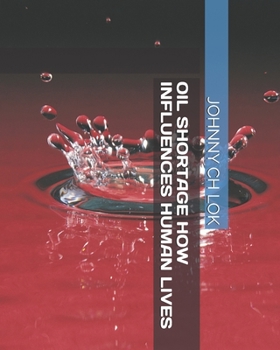
Oil Shortage How Influences Human Lives
No Customer Reviews

Household energy use: Applying behavioural economics to understand energy consumer decision-making and energy useful behaviour.Household energy conservation has emerged as a major challenge and opportunity for researchers, practitioners and policymakers. Consumers also seem to be gaining greater awareness of the value and need for sustainable energy practices, particularly amid growing public concerns over greenhouse gas emissions and climate change. With adequate knowledge of how to save energy and a professed desire to do so, many energy consumers still fail to take noticeable steps towards energy efficiency and conservation. There is often a sizeable discrepancy between peoples' self-reported knowledge, values, attitudes and intentions, and their observable behaviour-examples include the well-known 'knowledge-action gap' and 'value-action gap'. But neither is household energy consumption driven primarily by financial incentives and the rational pursuit of material interests. In fact, people sometimes respond in unexpected and undesirable ways to rewards and sanctions intended to shift consumers' cost-benefit analysis in favour of sustainable behaviours. Why is this so? Why is household energy consumption and conservation difficult to predict from either core values or material interests? By drawing on critical insights from behavioural economics and psychology, we illuminate the key cognitive biases and motivational factors that may explain why energy-related behaviour so often fails to align with either the personal values or material interests of consumers. Understanding these psychological phenomena can make household and community responses to public policy interventions less surprising, and in parallel, can help us design more cost-effective and mass-scalable behavioural solutions to encourage renewable and sustainable energy use among consumers.The elasticity of oil production and consumption influences energy consumer useful behaviorClassical economists still insist higher prices will bring out increased production sufficient to give us the oil we humans need.It applies to any nation that must import a substantial portion of its oil or natural gas.Elasticity to oil supply and demand frequent changesA quick lesson in economics. Elasticity. The production, or consumption, of a specific product is often referred to as being elastic - or - inelastic. If production is elastic, we assume that if the price of a product goes up, or if a shortage of the product develops, then competitors are able to add new capacity to increase the availability of that product. Higher prices and/or shortages encourage suppliers to invest in additional plant, equipment, materials, and labor in order to increase sales and profits. Economists generally believe that when this new capacity comes on-line, a surplus of product will eventually develop, and the resulting competition for business will force suppliers to reduce their prices in order to sell more products.
Format:Paperback
Language:English
ISBN:B08P6FF7KY
ISBN13:9798574701058
Release Date:January 1
Publisher:Independently Published
Length:60 Pages
Weight:0.31 lbs.
Dimensions:0.1" x 8.0" x 10.0"
Related Subjects
NatureCustomer Reviews
0 rating
Copyright © 2026 Thriftbooks.com
Terms of Use | Privacy Policy | Do Not Sell/Share My Personal Information | Cookie Policy | Cookie Preferences | Accessibility Statement
ThriftBooks ® and the ThriftBooks ® logo are registered trademarks of Thrift Books Global, LLC
ThriftBooks ® and the ThriftBooks ® logo are registered trademarks of Thrift Books Global, LLC
