


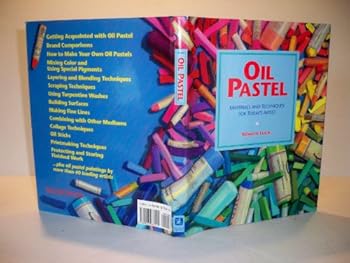
Oil Pastel : Materials and Techniques for Today's Artist


Here is an entire book devoted to oil pastel. This versatile medium is economical, fast, easy to transport, and it is less toxic than many other media, including oil paint, dry pastel, and encaustic.... This description may be from another edition of this product.
Format:Hardcover
Language:English
ISBN:0823033104
ISBN13:9780823033102
Release Date:August 1970
Publisher:Potter/Ten Speed/Harmony/Rodale
Length:144 Pages
Weight:0.13 lbs.
Dimensions:11.0" x 0.8" x 8.8"
Customer Reviews
5 ratings
Better condition than I expected
Published by Thriftbooks.com User , 16 years ago
Received the book in excellent condition and very quickly. I would buy from them again
Oil Pastel: Materials and Techniques for Today's Artist by Kenneth D. Leslie
Published by Thriftbooks.com User , 16 years ago
An excellent book - one of the few on Oil Pastels written. Detailed and insightful.
Good range of information on oil pastels
Published by Thriftbooks.com User , 16 years ago
This is one of only a few books on oil pastel available, and unfortunately it is out of print. I haven't yet seen the other (by John Elliot), so I can't compare which is better. Leslie starts with an overview of oil pastels. He describes the qualities of the different brands (unfortunately Arc-en-Ciel brand doesn't seem to exist anymore, they look like they would have been fun). He also shows the results of an informal lightfastness test he conducted of the brands. Leslie covers color, markmaking, mixing oil pastel with other media, and general "image directions": still life, landscape, figure/portrait, invention, and abstraction. He describes several ways to make fine lines, and shows ways to fix mistakes. It has a great variety of information on techniques useful for an artist just starting to use oil pastels. You are not going to read this book and find you have a technique down pat, because like all other art media, there is no one correct technique. Finding what works for your own art is a matter of trying things. Leslie obviously knows what he is doing but I don't always like his art - I find it too purposefully childlike. However, there is a great variety of artwork illustrating this book, from realism to abstraction, showing quite a range of what can be done with the medium. One useful thing in this book is a recipe for making your own oil pastels - I can't find another anywhere. Since Leslie uses stand oil in his recipe (a drying oil), this might more accurately be called an oil stick recipe. I believe Leslie's information on the chemistry and permanence of the medium is outdated and/or incorrect. He claims that the oil in oil pastels is a mixture of siccative (drying) and nondrying oils. In the section on permanence, he calls the siccative oils "more dependable", but siccative oils oxidize (and eventually ruin) unprotected paper. Everything else I've read claims oil pastels are made with "inert" nondrying oil that shouldn't damage paper, though I can find no definitive answer to this. I got my copy through interlibrary loan, read it through and copied down the useful information. I've been using oil pastel for a while so I don't feel the need to buy my own copy. If you are very interested in using oil pastels and can't borrow a copy, it is a worthwhile purchase.
Excellent source
Published by Thriftbooks.com User , 17 years ago
This is the ultimate resource for anyone interested in the medium. I've read it cover to cover twice and have referred to it a number of times. Although I've also worked in pastels, I enjoy oil pastels the most. It's like sculpting on paper. An inspirational source ...
Oil Pastel: Materials and Techniques for Today's Artist
Published by Thriftbooks.com User , 26 years ago
This is an unusually thorough book. If you can get your hands on a copy, you should do so. Unfortunately, it is out of print. The publisher is Watson-Guptill and the book was originally published in 1990. The ISBN No. is 0-8230-3310-4. Here's why the book wins my vote: It has a ton of pictures of finished art works done in oil pastel and in mixed media, using oil pastel and other media. There is a section which tells of the lightfastness of different brands of oil pastel currently on the market so readers can see actual pictures of brands exposed to sunlight for 3 months and how the sunlight does/doesn't alter the colors. There is also a "nitty-gritty" section describing the characteristics of each major brand available on the market currently, as of 1990 when the book was written, but these are the same brands available today (creaminess, hardness and what you can do with each). There are detailed diagrams of different methods of using oil pastels, broken down into steps, so readers have step by step directions of how to use oil pastels in a variety of ways. There are many ideas for composition using oil pastels. The author, Kenneth Leslie, makes it a point to tell readers exactly how each of the many works shown were developed in oil pastel (e.g., by direct observation of objects such as in a still-life, or by using photographs or collage, etc.) and on what kind of supports (e.g. which grounds to use on paper, museum board, masonite, wood, etc.) There are just lots and lots of pointers about using the medium of oil pastel. Many ideas of using oil pastels in concert with other media serve as a springboard for individual ideas. For example, I read a section of explanation and then, quite easily, I could mentally figure out how to apply the techniques shown to my own work. This will be my bible for doing oil pastel painting.
Copyright © 2026 Thriftbooks.com
Terms of Use | Privacy Policy | Do Not Sell/Share My Personal Information | Cookie Policy | Cookie Preferences | Accessibility Statement
ThriftBooks ® and the ThriftBooks ® logo are registered trademarks of Thrift Books Global, LLC
ThriftBooks ® and the ThriftBooks ® logo are registered trademarks of Thrift Books Global, LLC
